SOC 2 Compliance Checklist 2026: 50+ Controls You Need
SOC 2 compliance has become a non-negotiable requirement for SaaS companies, cloud service providers, and any business that handles customer data. If your sales team is fielding security questionnaires on every deal, or if enterprise customers are asking for your SOC 2 report before signing, this checklist will give you a clear path from zero to audit-ready.
This guide covers everything: what SOC 2 actually requires, the difference between Type 1 and Type 2, a step-by-step checklist for each Trust Services Criteria, and the mistakes that cause companies to fail or delay their audits.
What SOC 2 Is and Why It Matters
SOC 2 (System and Organization Controls 2) is an auditing standard developed by the American Institute of Certified Public Accountants (AICPA). It evaluates how a service organization manages customer data across five Trust Services Criteria: Security, Availability, Processing Integrity, Confidentiality, and Privacy.
Unlike certifications such as ISO 27001, SOC 2 produces an attestation report from a licensed CPA firm. The report is shared with customers and prospects under NDA. It tells them: a qualified third party reviewed your controls and verified they work.
For B2B SaaS companies, a SOC 2 report can directly accelerate deal velocity. According to Vanta's 2024 State of Trust Report, 78% of enterprise buyers require a SOC 2 report before signing contracts with new software vendors. Waiting to pursue compliance is not a neutral decision; it is costing you revenue.
SOC 2 Type 1 vs Type 2: Which One Do You Need?

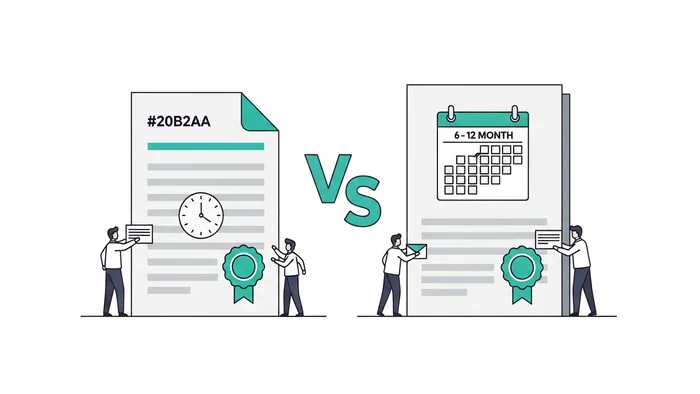
Type 1 reports verify that your controls are designed correctly at a single point in time. Type 2 reports verify that those controls actually operated effectively over a defined observation period, typically 6 to 12 months.
Type 1 is faster to obtain (4 to 8 weeks from readiness to report) and costs significantly less. It works as a credibility signal for early-stage companies that need something to show prospects immediately. Type 2 carries more weight because it demonstrates sustained operational discipline, not just a well-written policy document.
Most enterprise buyers ultimately want a Type 2 report. A practical sequencing strategy is to pursue Type 1 first to close near-term deals, then start the observation period for Type 2 immediately after. This way you have a usable artifact now while building toward the more respected credential.
The Five Trust Services Criteria Explained
Only the Security criterion (also called the Common Criteria) is mandatory for every SOC 2 engagement. The other four are selected based on what your customers care about and what services you provide.
Security covers logical and physical access controls, risk management, change management, and incident response. It is the foundation of every SOC 2 report.
Availability applies if your customers depend on your service being up. It covers uptime commitments, disaster recovery, and capacity monitoring.
Processing Integrity is relevant for companies that process financial transactions or other high-stakes data workflows. It confirms that your system processes data completely, accurately, and on time.
Confidentiality applies when you handle data that customers expect to be kept private, such as trade secrets, business plans, or financial records.
Privacy applies if you collect, use, retain, or disclose personal information. It aligns with the AICPA's Generally Accepted Privacy Principles (GAPP), which overlap substantially with GDPR and CCPA requirements.
The Complete SOC 2 Compliance Checklist
Work through these sections in order. Each maps directly to audit evidence you will need to provide.
Phase 1: Scoping and Readiness (Weeks 1-2)
Define your system boundary before doing anything else. Your auditor will ask you to describe exactly what systems, processes, and people are in scope.
- [ ] Identify all systems that store, process, or transmit customer data (production databases, cloud infrastructure, SaaS tools used by your team)
- [ ] Document your service description: what your product does, who uses it, and what data it handles
- [ ] Identify subservice organizations (AWS, Stripe, Salesforce) that are part of your service delivery
- [ ] Select which Trust Services Criteria apply to your business
- [ ] Choose a readiness assessment approach: internal gap analysis, compliance platform (Vanta, Drata, Secureframe), or external consultant
- [ ] Assign an internal compliance owner with executive sponsorship
Phase 2: Security Criterion Controls
The Common Criteria covers nine control categories. Every item below maps to a required control.
Control Environment:
- [ ] Board or senior leadership acknowledges responsibility for the control environment
- [ ] Written security policy exists and has been communicated to all employees
- [ ] Code of conduct and acceptable use policies are signed by all staff
Risk Assessment:
- [ ] Formal risk assessment process is documented and performed at least annually
- [ ] Risk register exists with identified threats, likelihood ratings, and mitigating controls
- [ ] Vendor/subprocessor risk assessments are completed for all critical third parties
Logical Access Controls:
- [ ] Unique user accounts are required for all systems (no shared credentials)
- [ ] Multi-factor authentication (MFA) is enforced on all systems that access customer data
- [ ] Privileged access (admin rights) is restricted and reviewed quarterly
- [ ] Access provisioning and deprovisioning procedures are documented and followed within 24 hours of role changes
- [ ] Quarterly user access reviews are conducted and documented
Change Management:
- [ ] Separate development, staging, and production environments exist
- [ ] Code changes require peer review before merging to production
- [ ] Production deployments follow a documented change management process
- [ ] Customer data is not used in development or testing environments
Incident Response:
- [ ] Incident response plan is documented and includes defined severity levels, roles, and escalation paths
- [ ] Security incidents are logged, investigated, and resolved with documented outcomes
- [ ] At least one incident response tabletop exercise is conducted annually
- [ ] Customer notification procedures exist for security incidents
System Monitoring:
- [ ] Logging is enabled on all in-scope systems (authentication events, admin actions, data access)
- [ ] Logs are stored in a centralized location and retained for at least 12 months
- [ ] Automated alerts exist for anomalous activity (failed logins, privilege escalation, unusual data exports)
- [ ] Vulnerability scanning is performed at least quarterly
- [ ] Penetration testing is performed annually by a qualified external firm
Physical Security:
- [ ] If you operate your own hardware: physical access to server rooms is restricted and logged
- [ ] For cloud-only companies: document your reliance on AWS/GCP/Azure physical security controls (covered by their SOC 2 reports)
Vendor Management:
- [ ] Inventory of all third-party vendors with access to customer data
- [ ] Vendor security assessments are completed before onboarding critical vendors
- [ ] Data processing agreements (DPAs) are executed with all vendors that process personal data
- [ ] Annual vendor review process is documented
Business Continuity:
- [ ] Disaster recovery plan is documented with defined Recovery Time Objective (RTO) and Recovery Point Objective (RPO)
- [ ] Backups are automated, encrypted, and tested for restoration at least annually
- [ ] Business continuity plan covers key personnel dependencies and communication procedures
Phase 3: Additional Criteria Checklists
Availability (if selected):
- [ ] Uptime commitment is documented in customer agreements
- [ ] Capacity monitoring and alerting are in place
- [ ] Disaster recovery tests are conducted at least annually with results documented
- [ ] Status page or customer communication process exists for outages
Processing Integrity (if selected):
- [ ] Input validation controls prevent incomplete or malformed data from being processed
- [ ] Processing errors are detected, logged, and resolved with documented procedures
- [ ] Output reconciliation procedures verify completeness of processed data
Confidentiality (if selected):
- [ ] Confidential data is classified and labeled
- [ ] Encryption at rest and in transit is enforced for confidential data
- [ ] Confidential data disposal procedures are documented and followed
Privacy (if selected):
- [ ] Privacy notice discloses data collection practices, purposes, and retention periods
- [ ] Procedures exist for responding to data subject access, deletion, and correction requests
- [ ] Personal data inventory maps what data is collected, where it is stored, and how long it is retained
- [ ] Consent mechanisms are implemented where required
Phase 4: Documentation and Evidence Collection (Weeks 3-8)
Your auditor will request evidence for every control. Organize it before the audit begins.
- [ ] Create a policy library: information security policy, access control policy, change management policy, incident response policy, vendor management policy, acceptable use policy, data classification policy
- [ ] Collect screenshots, exports, and logs that demonstrate each control is operating
- [ ] Document your control testing procedures (how you verify controls work internally)
- [ ] Prepare your system description document (required for all SOC 2 reports)
Phase 5: Audit Preparation (Weeks 8-12)
- [ ] Select a licensed CPA firm to perform the audit
- [ ] Agree on scope, criteria, and observation period with your auditor
- [ ] Complete a pre-audit readiness assessment or internal gap analysis
- [ ] Remediate any identified gaps before the audit observation period begins
- [ ] Assign an audit liaison who will coordinate evidence requests
Common Mistakes That Delay SOC 2 Audits

The most common failure mode is treating SOC 2 as a documentation project rather than an operational one. Policies without evidence of implementation will fail.
Mistake 1: Incomplete access reviews. Auditors look for evidence that access reviews actually happened, with names, dates, and documented decisions. A spreadsheet with no dates or signatures does not pass.
Mistake 2: Shared accounts and credentials. Shared admin accounts are a direct violation of the logical access controls criteria. Every person needs a unique account.
Mistake 3: No separation between production and development. Using production data in development environments is a control failure. Document your separation and enforce it technically where possible.
Mistake 4: Missing vendor assessments. Every critical subservice organization needs a documented security review. Many companies complete their own policies but forget to assess AWS, GitHub, or their CRM.
Mistake 5: Starting the observation period too early. If you start your Type 2 observation period before your controls are fully operational, you will accumulate exceptions throughout the period. Fix your gaps first, then start the clock.
SOC 2 Updates and Changes for 2026
The SOC 2 compliance landscape has shifted in 2026 in ways that change what auditors look for and what GRC platforms ship. Below is what changed and how to update your control set.
AICPA Trust Services Criteria 2026 Guidance
The AICPA released updated SOC 2 Trust Services Criteria guidance in late 2025, effective for examination periods beginning January 1, 2026. The five categories (Security, Availability, Processing Integrity, Confidentiality, Privacy) did not change, but several common criteria received clarified expectations:
- CC6.1 (Logical access). Stronger emphasis on least-privilege access reviews and time-bound access for privileged accounts. Standing admin access without periodic re-justification is a common 2026 finding.
- CC6.6 (Boundary protection). Expanded scope to cover cloud network segmentation, including VPC boundary controls and east-west traffic monitoring. Auditors now expect explicit evidence of cloud network egress controls.
- CC7.2 (Anomaly monitoring). Updated guidance recognizes AI and ML-based anomaly detection as in-scope evidence. Teams using SIEM with behavioral analytics can satisfy this criterion more easily than in prior years.
- CC9.2 (Vendor management). Tighter expectations around continuous vendor risk monitoring rather than annual point-in-time reviews. Subservice organizations now require evidence of ongoing assessment.
What Changed for Auditors
CPA firms have updated their internal audit programs to reflect the 2026 guidance. Practical effects:
- More sample testing on access reviews. Expect auditors to pull 25 to 40 access samples instead of 10 to 15.
- Stricter evidence on production change management. Auditors want evidence the change was approved before deployment, not retroactively.
- Increased scrutiny on subprocessor inventories. Expect a list of every subprocessor (not just primary subservice organizations) with their data access scope.
- Greater interest in incident response runbooks and tabletop exercise documentation.
What Changed for GRC Platforms
Vanta, Drata, Sprinto, and Secureframe rolled 2026 updates into their platforms in Q1 2026:
- AI questionnaire automation now answers 70 to 80 percent of inbound security reviews automatically.
- Continuous compliance monitoring dashboards added more granular control drift alerts.
- Automated subprocessor inventory and risk scoring became standard.
- Trust centers added native NDA workflows and downloadable SOC 2 Type 2 report distribution.
How to Update Your SOC 2 2026 Compliance Plan
If your last SOC 2 report was issued in 2024 or 2025, plan these adjustments before your next audit window:
- Review your access review cadence. Quarterly reviews with documented justifications now match auditor expectations more cleanly than annual reviews.
- Document your subprocessor inventory with data scope for each. AWS, GitHub, your CRM, your HRIS, your monitoring tools, your CDN, and your email provider all need entries.
- Map your SIEM or security monitoring tool output to CC7.2 evidence. Save monthly anomaly reports as audit artifacts.
- Run at least one tabletop incident response exercise per year and save the playbook execution notes.
- Confirm your GRC platform pulled the updated AICPA TSC mappings into its control library. All four major platforms shipped 2026 mappings in Q1.
For broader context on how SOC 2 compares to other frameworks, see our SOC 2 vs ISO 27001 and SOC 2 vs SOC 1 guides.
SOC 2 Timeline and Cost Overview
A realistic timeline for a first-time SOC 2 Type 1 engagement is 3 to 6 months from decision to report. Type 2 adds the observation period: plan for 9 to 18 months total.
Cost varies significantly by approach. Using a compliance automation platform (Vanta, Drata, Secureframe) costs $10,000 to $30,000 per year in platform fees. Audit firm fees for Type 1 range from $15,000 to $30,000 for small companies. Type 2 audit fees range from $20,000 to $75,000 depending on scope and company size.
All-in, a small company (10 to 50 employees) should budget $25,000 to $60,000 for their first Type 2 report including platform, readiness work, and audit fees. Larger companies (50 to 200 employees) should budget $50,000 to $120,000.
For a detailed cost breakdown by company size and approach, see our companion article: How Much Does a SOC 2 Audit Actually Cost in 2026?
Frequently Asked Questions

How long does SOC 2 compliance take? For Type 1, plan for 3 to 6 months from the decision to the report. This includes 4 to 8 weeks of readiness work and 4 to 8 weeks for the audit itself. Type 2 requires an additional observation period of 6 to 12 months, making the total timeline 9 to 18 months for a first-time report. Companies with mature security programs already in place can compress these timelines.
Do all five Trust Services Criteria need to be included? No. Only the Security criterion (Common Criteria) is mandatory. The remaining four, Availability, Processing Integrity, Confidentiality, and Privacy, are optional and should be selected based on your customers' contractual requirements and the nature of your service. Most SaaS companies start with Security only and add Availability if their customers require uptime guarantees.
What is the difference between SOC 2 and ISO 27001? Both address information security management, but they differ in structure and use. SOC 2 is a CPA-attested report specific to North American enterprise buyers. ISO 27001 is an internationally recognized certification that involves a registrar audit and annual surveillance audits. ISO 27001 tends to carry more weight in European markets. Many controls overlap, and pursuing one makes the other easier to achieve. Neither is universally superior; it depends on where your customers are and what they require. The AICPA, which governs SOC 2 standards, publishes its Trust Services Criteria at aicpa.org. For a comparison of the compliance platforms that automate this process, see Vanta vs Drata vs Secureframe.
Can a startup pursue SOC 2 compliance? Yes, and many do earlier than you might expect. If you are closing Series A deals with enterprise buyers, you will likely encounter SOC 2 requirements. Early-stage companies often use compliance automation platforms to reduce the internal burden. The key is not to wait until you have a dedicated security team; the readiness process itself forces good security hygiene and is valuable regardless of the audit outcome.
What happens if we fail a SOC 2 audit? SOC 2 audits do not produce pass/fail outcomes. Auditors issue qualified or unqualified opinions. An unqualified opinion means your controls operated effectively. A qualified opinion means the auditor found exceptions: specific controls that did not operate as described. Qualified reports are disclosed to your customers, which can damage trust. The practical consequence is having to remediate the exceptions and conduct a follow-up audit. Thorough readiness work exists specifically to avoid this outcome.