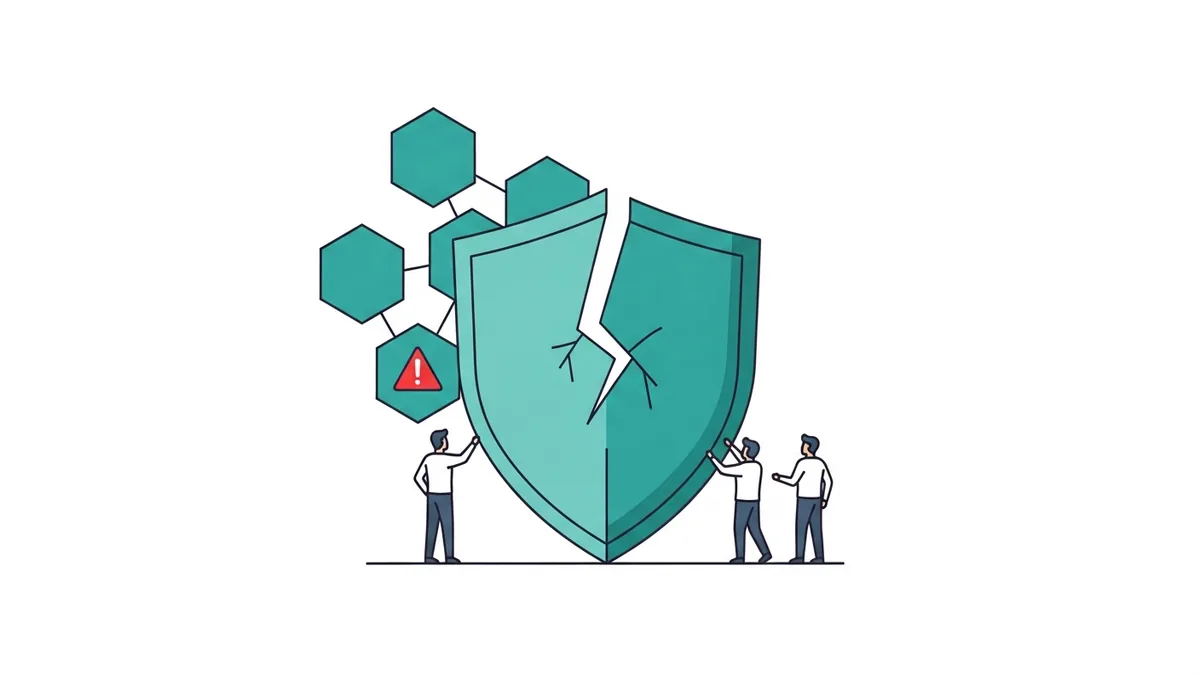
SolarWinds Hack: 6 Compliance Lessons from the 2020 Supply Chain Attack
TL;DR
- Russian state actors (APT29/NOBELIUM) planted a backdoor called SUNBURST inside SolarWinds Orion software updates distributed March through June 2020. Roughly 18,000 organizations installed the trojanized update before detection in December 2020.
- The attackers entered through the build pipeline, not the application. SUNSPOT, a separate tool on SolarWinds' build servers, replaced source code during Orion compilation, so the resulting binaries were legitimately signed and trusted by every endpoint protection product.
- Only around 100 of the 18,000 installations saw follow-on hands-on exploitation. The rest were foothold positions the attackers chose not to activate.
- The breach produced six named compliance failures, all of which now map directly to controls in NIST CSF 2.0, SOC 2, ISO 27001, and PCI DSS 4.0.
- In October 2023, the SEC named SolarWinds and its CISO Timothy Brown in a fraud complaint, the first time a sitting CISO was personally charged in a cyber disclosure enforcement action.
Who This Is For
This article is for compliance program owners, security engineers, and GRC leads who need to understand the SolarWinds breach as a concrete control failure map, not as a history lesson. If your organization builds software, ships agents with privileged access, or sells to federal customers, the regulatory changes this incident triggered apply to you directly.
What Happened: The Attack Timeline

In September 2019, Russian state-sponsored actors tracked by CISA as APT29 and by Mandiant as UNC2452 (later merged into APT29/NOBELIUM) first tested code injection into SolarWinds Orion builds, according to CISA's analysis. By February 2020, a tool called SUNSPOT was running on SolarWinds' build infrastructure.
CrowdStrike's January 2021 analysis of SUNSPOT detailed how it worked: SUNSPOT monitored build processes for MsBuild.exe instances handling Orion compilation. When found, it replaced the source file InventoryManager.cs with a backdoored version. After compilation, it restored the original, leaving no trace in source control. The resulting binary was signed with SolarWinds' valid Authenticode certificate.
Key dates in the incident timeline:
- September 2019: Initial test injections into Orion builds
- February 20, 2020: SUNSPOT binary compiled (per build timestamp recovered by CrowdStrike)
- March-May 2020: Trojanized Orion updates signed and distributed to customers
- December 8, 2020: FireEye discloses theft of its red team tools, triggering its own investigation
- December 13, 2020: Mandiant (then FireEye) publishes the SUNBURST analysis; SolarWinds and the U.S. Treasury Department confirm the breach
- December 17, 2020: CISA issues Emergency Directive 21-01 ordering federal agencies to disconnect Orion immediately
- January 11, 2021: CrowdStrike publishes SUNSPOT technical details
- October 30, 2023: SEC files fraud charges against SolarWinds and its CISO Timothy Brown
Scale vs. exploitation: SolarWinds disclosed in its December 2020 SEC 8-K filing that approximately 18,000 customers installed the trojanized update. Of those, Mandiant's investigation found that around 100 organizations experienced follow-on hands-on-keyboard activity. The attackers used selective criteria, checking domain names against a blocklist of security vendors and internal SolarWinds environments, before activating SUNBURST fully. This is the defining characteristic of modern supply chain attacks: build a wide foothold, then exploit a narrow selection.
The Six Compliance Failures
The SolarWinds compromise was not caused by a zero-day in Orion. Every one of the six failures below maps to controls that existed in major frameworks before December 2020 and that auditors now treat as high-priority examination areas.
Failure 1: Build Pipeline Was Not Segregated
SUNSPOT ran on SolarWinds' build servers with enough access to monitor MsBuild.exe processes, read source file paths from build memory, replace source files, and restore them after compilation. CrowdStrike's analysis confirmed the malware ran from a scheduled task on those servers and wrote encrypted logs to a file disguised as a VMware log.
The build environment was not treated as a high-privilege, high-scrutiny environment. NIST SP 800-218 (SSDF), published February 2022 in direct response to this breach, specifies practice PS.3.1: protect all forms of code from unauthorized access and tampering. SOC 2 CC8.1 addresses change management with segregation of duties. ISO 27001:2022 A.8.31 requires separation of development, test, and production environments. None of those controls were operational in the SolarWinds build environment at the time of compromise.
Failure 2: Code Signing Was Treated as Proof of Integrity
Because SUNSPOT replaced source files before compilation, the final binaries passed through SolarWinds' standard signing process untouched. Customers received a perfectly signed DLL from a vendor they trusted.
This failure exposed a gap that compliance frameworks have since addressed explicitly. Code signing authenticates a publisher; it does not prove that the code is what the publisher intended to ship. NIST SP 800-218 PS.2 requires mechanisms for verifying software release integrity, including reproducible builds and software bills of materials (SBOMs). Executive Order 14028, signed May 2021, mandates SBOMs and secure software attestation for software sold to the federal government precisely because SolarWinds showed that signing alone was insufficient.
Failure 3: Third-Party Risk Assessment Did Not Model the Install Footprint
Orion ran with domain admin privileges inside thousands of customer environments because it needed to query Active Directory, Exchange, VMware, and network infrastructure for monitoring purposes. Few customers had mapped the consequence of an attacker gaining control of that footprint.
NIST SP 800-161 Rev. 1 (published May 2022, updated November 2024) codifies C-SCRM: organizations must identify, assess, and mitigate cybersecurity risks throughout their supply chains, with particular attention to products that run with elevated privilege. SOC 2 CC9.2 requires documented vendor and business partner risk management. HIPAA §164.308(b) requires business associate agreements plus ongoing due diligence on those with access to protected health information.
The compliance failure here was not using an unvetted vendor; it was failing to ask "what could an attacker do from inside this agent's access scope?" before deployment.
Failure 4: Lateral Movement and Token Abuse Went Undetected
After establishing a foothold via SUNBURST, attackers used a technique called Golden SAML to forge Security Assertion Markup Language tokens and access Microsoft 365 cloud resources. Microsoft confirmed in its December 2020 disclosure that it detected malicious SolarWinds binaries in its own environment and found no evidence of access to production services or customer data. For less mature victims, the outcomes were worse: email exfiltration and sustained espionage access that persisted until FireEye published indicators of compromise.
Mandiant's tracking of UNC2452 showed the attackers operated inside victim environments for an extended period before detection. The June 2020 malware introduction with December 2020 discovery represents roughly six months of undetected access in many environments.
SOC 2 CC7.2 and CC7.3 require continuous monitoring and incident detection. PCI DSS 4.0 Requirement 10 mandates detailed logging and review. The NIST Cybersecurity Framework 2.0 Detect function exists to reduce exactly this kind of dwell time. Victims who had mature identity provider monitoring, watching for token anomalies and impossible travel patterns, caught the activity earlier than those relying on perimeter controls.
Failure 5: Privileged Access Controls Were Loose
Reuters reported that during Senate Intelligence Committee testimony, a former intern was cited in connection with a password ("solarwinds123") found on an internet-accessible SolarWinds file server. Weak credentials on individual servers did not cause the build-pipeline compromise, but they reflect an organizational posture where privileged access was not treated as a controlled surface.
NIST SP 800-53 IA-5 (Authenticator Management) and AC-6 (Least Privilege) address credential strength and access minimization. ISO 27001 A.5.15 through A.5.18 cover identity and access management end to end. SOC 2 CC6.1 requires logical access protection including MFA for privileged accounts. Auditors examining this failure in a current SOC 2 engagement would look for evidence of privileged account inventory, MFA enforcement records, and periodic access reviews, not just a policy document.
Failure 6: Internal Risk Knowledge Did Not Reach Public Disclosures
In October 2023, the SEC filed fraud charges against SolarWinds and its CISO Timothy Brown. The complaint alleged that internal communications and assessments showed the company knew about significant cybersecurity weaknesses going back years while public-facing disclosures described its security controls as strong.
A federal district court (S.D.N.Y.) partially dismissed the SEC's claims against SolarWinds in July 2024, dismissing the pre-breach disclosure counts while sustaining the post-breach disclosure claims, according to publicly available case records (case no. 1:23-cv-09518). The case remains the first instance of the SEC naming a sitting CISO as a personal defendant in a cyber fraud enforcement action, and it sits directly behind the SEC's 2023 cybersecurity disclosure rules requiring public companies to disclose material cyber incidents within four business days and to report annually on cybersecurity risk management and governance.
Regulatory inflection point: The SolarWinds breach drove compliance requirements in two simultaneous directions. Upstream, SSDF and C-SCRM push software vendors to harden build pipelines and attest to their practices. Downstream, SEC disclosure rules and CIRCIA push incident victims to report faster and more accurately. Compliance teams now have obligations on both sides of that equation.
The Regulatory Response: What Changed
The table below shows the rules that trace directly to SolarWinds. All are in effect for compliance purposes as of 2026.
| Rule or framework | Effective | SolarWinds connection |
|---|---|---|
| Executive Order 14028 | May 2021 | Mandates SBOMs, secure software attestation, zero trust for federal agencies |
| NIST SP 800-218 (SSDF) | Feb 2022 | First normative federal standard for secure software development practices |
| NIST SP 800-161 Rev. 1 (C-SCRM) | May 2022 | Cybersecurity supply chain risk management framework for systems and organizations |
| OMB M-22-18 / M-23-16 | 2022-2023 | Federal software vendors must self-attest to SSDF compliance |
| CISA Secure by Design | Apr 2023 | Software vendor responsibility for shipping secure defaults |
| SEC Cyber Disclosure Rule | Dec 2023 | 4-business-day material incident disclosure; annual cyber risk reporting |
If you sell software to U.S. federal agencies, hold SOC 2 attestations for enterprise buyers, or participate in healthcare or finance supply chains, these rules are not optional reading.
The Financial and Legal Aftermath

SolarWinds disclosed breach-related costs in its public SEC filings. In its Q1 2021 10-Q filing (available on SEC EDGAR), the company reported over $40 million in direct incident response and investigation costs. By year-end 2022, cumulative remediation, security rebuild, and legal defense costs exceeded $68 million, per the company's annual filings.
A shareholder class action suit settled for $26 million in 2022. Separate derivative suits and Department of Justice actions continued or settled in subsequent years.
The reputational cost is harder to quantify. SolarWinds' stock declined sharply in the week following the December 13, 2020 disclosure, with multiple financial data sources at the time reporting a drop in the range of 35% or more. [Editorial estimate based on publicly available stock price data from the disclosure week; we have not linked a specific data terminal source.] The company spent the following years rebuilding its security program under external scrutiny, including publishing its Secure by Design journey publicly as part of its go-forward positioning.
Note: Federal government remediation cost estimates vary significantly by source and scope. This article does not cite a specific government-wide figure because no single primary source with a defined methodology is publicly accessible to verify.
Framework Mapping: SolarWinds Failures to Controls
For compliance teams building audit-ready programs, the following table maps each SolarWinds failure to the specific controls that address it.
| Failure | NIST CSF 2.0 | SOC 2 | ISO 27001 | PCI DSS 4.0 |
|---|---|---|---|---|
| Build pipeline compromise | PR.PS-1, PR.PS-6 | CC8.1 | A.8.31 | 6.5 |
| Code signing abuse | PR.PS-5 | CC8.1 | A.8.30 | 6.3.2 |
| Third-party risk gap | ID.SC-1 through SC-4 | CC9.2 | A.5.19-A.5.23 | 12.8 |
| Lateral movement undetected | DE.CM-1, DE.CM-7 | CC7.2, CC7.3 | A.8.16 | 10.4, 11.5 |
| Weak privileged access | PR.AA-1, PR.AA-4 | CC6.1 | A.5.15-A.5.18 | 7.1, 8.3 |
| Disclosure failure | GV.SC-09, RS.CO | CC2.3 | A.5.24, A.5.26 | 12.10 |
If you cannot produce evidence for any row in this table before your next audit, that row is a gap worth prioritizing.
The Six Controls to Act on Now
SolarWinds is a control map more than a case study. These are the six actions that matter most for compliance programs in 2026:
1. Adopt SSDF practices for software you build or buy. NIST SP 800-218 is short and actionable. The three categories that matter most for supply chain risk are PS (protect the software), PW (produce well-secured software), and RV (respond to vulnerabilities). If you sell to federal customers, you will be asked to attest to these practices under OMB M-22-18.
2. Require and consume SBOMs. If you ship software, publish a Software Bill of Materials. If you consume software, demand one from critical vendors. An SBOM does not prevent a SUNSPOT-style build-pipeline compromise, but when a new CVE surfaces in a common library, it turns a weeks-long hunt into a database query. CISA's SBOM resources page documents the minimum required elements.
3. Perform C-SCRM on vendors running with privilege in your environment. NIST SP 800-161 Rev. 1 gives the framework. For each vendor agent or product running with local admin, domain admin, or equivalent privilege: document the access scope, model the attacker scenario from that footprint, and justify why the privilege level is necessary.
4. Instrument identity provider activity. The earliest SolarWinds signals were in identity: token anomalies, impossible travel patterns, single accounts authenticating to many systems in short windows. Microsoft's detection guidance for Solorigate published in December 2020 still provides the relevant indicators. If your SIEM is not ingesting identity provider logs with alerting on SAML token anomalies, this is a gap.
5. Build your SEC disclosure workflow before you need it. The SEC's cybersecurity disclosure rule requires public companies to disclose material cyber incidents within four business days of determining materiality. Your legal team, CISO, investor relations function, and compliance team should have a documented runbook and a rehearsed materiality framework before an incident occurs. SolarWinds' enforcement case showed that the gap between internal risk knowledge and public disclosure is now legally actionable.
6. Audit privileged install footprints quarterly. Every monitoring agent or management tool running with local admin or domain admin rights is a potential Orion. Quarterly, inventory these agents, document their access scope, verify that least-privilege alternatives are not available, and rotate their credentials. This is less about any single framework requirement and more about eliminating the class of attacker opportunity that SolarWinds provided.
What This Means for Software Vendors and Startups

If you build software that customers install in their environments, expect supply chain security questions in every enterprise security review starting now. The specific questions buyers ask have standardized around the SSDF attestation process:
- Do you have a Software Bill of Materials for your product?
- Is your build environment separated from developer endpoints?
- How do you verify the integrity of third-party dependencies in your CI pipeline?
- What is your process for detecting compromised packages?
- If you sell to federal customers, how do you meet the OMB M-22-18 attestation requirement?
A one-page supply chain security statement grounded in NIST SP 800-218 practices will unblock enterprise procurement conversations and reduce questionnaire fatigue. It does not need to cover every control, it needs to be honest and specific about what you have and what you are working toward.
In practice, compliance teams reviewing vendor questionnaires most often find that the hardest question to answer is not the policy question ("do you have a build environment policy?") but the evidence question ("show me the last time you reviewed access to your build servers and what you found"). Organizations that have thought through these questions before a procurement review almost always surface at least one finding that needed attention. The SolarWinds case makes the audit case for doing that work before a vendor questionnaire forces it.
FAQ
Is SolarWinds Orion still safe to use?
SolarWinds rebuilt its secure software development lifecycle with third-party attestations following the breach and has been one of the most publicly scrutinized software vendors in the industry since 2020. The lesson from SolarWinds is not to avoid one specific product, but to apply C-SCRM to every vendor running with privilege in your environment, regardless of how trusted they appear.
What is the difference between SUNBURST, SUNSPOT, and TEARDROP?
SUNSPOT was the implant on SolarWinds' build servers that injected malicious code into Orion source files during compilation. SUNBURST is the backdoor that resulted from that injection and shipped inside signed Orion updates to customers. TEARDROP was a post-exploitation memory-only dropper used against a smaller subset of victims to deploy additional tools after SUNBURST had established access.
Did SolarWinds qualify as a HIPAA or GDPR breach for affected organizations?
For any healthcare organization that detected SUNBURST-related access to systems containing protected health information, a HIPAA breach notification analysis under 45 CFR §164.400-414 was required. EU entities assessed GDPR Article 33 obligations against evidence of actual data access. The analysis was victim-specific and depended on what the attacker accessed in each environment, not on the mere presence of the trojanized update.
What is C-SCRM and why does it appear in SOC 2 audits now?
C-SCRM (Cybersecurity Supply Chain Risk Management), defined in NIST SP 800-161 Rev. 1, is the practice of identifying, assessing, and managing cybersecurity risk introduced by suppliers, their products, and their services. SOC 2 auditors examine CC9.2 (vendor and business partner risk management) with increasing specificity, and since SolarWinds, many auditors explicitly ask for C-SCRM evidence, documented vendor risk assessments, privileged access inventories, and third-party review cadences, not just a vendor management policy.
How do SBOMs actually reduce supply chain risk?
An SBOM does not prevent a compromised build. Its value is in reducing time-to-triage after disclosure. When a new CVE surfaces in a common open-source library, an SBOM lets you run a query against your software inventory to identify every product that ships that library. Without an SBOM, the same exercise is a manual audit across source repositories.
What single control would have had the most impact on SolarWinds?
There is no single control. The attack succeeded by chaining several gaps. A hardened, isolated build environment with integrity verification of source files at compilation time (NIST SSDF PS.3.1) would have made SUNSPOT's file-substitution technique detectable, if not impossible. Combine that with SBOM-based integrity verification of releases and C-SCRM that evaluated what an attacker could do from inside Orion's access footprint, and the scenario changes materially.
Sources
- Mandiant (Google Cloud), "Evasive Attacker: SolarWinds Supply Chain Compromise with SUNBURST Backdoor," December 13, 2020. Mandiant SUNBURST initial disclosure, Tier 2. Accessed 2026-05-12.
- Mandiant (Google Cloud), "SUNBURST Additional Technical Details," December 24, 2020. Mandiant SUNBURST technical analysis, Tier 2. Accessed 2026-05-12.
- CrowdStrike, "SUNSPOT: An Implant in the Build Process," January 11, 2021. https://www.crowdstrike.com/blog/sunspot-malware-technical-analysis/, Tier 2. Accessed 2026-05-12.
- NIST, "Secure Software Development Framework (SSDF) Version 1.1: Recommendations for Mitigating the Risk of Software Vulnerabilities," SP 800-218, February 2022. https://csrc.nist.gov/pubs/sp/800/218/final, Tier 1. Accessed 2026-05-12.
- NIST, "Cybersecurity Supply Chain Risk Management Practices for Systems and Organizations," SP 800-161 Rev. 1, May 2022 (updated November 2024). https://csrc.nist.gov/pubs/sp/800/161/r1/upd1/final, Tier 1. Accessed 2026-05-12.
- SEC, "SEC Charges SolarWinds and Chief Information Security Officer with Fraud, Internal Control Failures," October 30, 2023. https://www.sec.gov/news/press-release/2023-227, Tier 1.
- SEC, "SEC Adopts Rules on Cybersecurity Risk Management, Strategy, Governance, and Incident Disclosure by Public Companies," July 26, 2023. https://www.sec.gov/news/press-release/2023-139, Tier 1.
- The White House, "Executive Order on Improving the Nation's Cybersecurity," May 12, 2021. https://www.whitehouse.gov/briefing-room/presidential-actions/2021/05/12/executive-order-on-improving-the-nations-cybersecurity/, Tier 1.
- Microsoft, "Ensuring customers are protected from Solorigate," December 15, 2020. https://www.microsoft.com/en-us/security/blog/2020/12/15/ensuring-customers-are-protected-from-solorigate/, Tier 2. Accessed 2026-05-12.
- HHS Office for Civil Rights, HIPAA Breach Notification Rule. https://www.hhs.gov/hipaa/for-professionals/breach-notification/index.html, Tier 1.
- SolarWinds, Form 10-Q for Q1 2021 (filing with breach response cost disclosures). Available via SEC EDGAR at https://www.sec.gov/cgi-bin/browse-edgar?action=getcompany&CIK=0001739942&type=10-Q, Tier 1 (SEC filing).
- CISA, "Emergency Directive 21-01: Mitigate SolarWinds Orion Code Compromise," December 17, 2020. https://www.cisa.gov/news-events/directives/ed-21-01, Tier 1. Accessed 2026-06-23.
- CISA, "Alert (AA20-352A): Advanced Persistent Threat Compromise of Government Agencies, Critical Infrastructure, and Private Sector Organizations," December 17, 2020. https://www.cisa.gov/news-events/alerts/2020/12/17/sunburst-supply-chain-attack, Tier 1. Accessed 2026-05-12.
Last reviewed: 2026-06-23. This article was prepared by the Security Compliance Guide Editorial Team. We use AI to draft initial summaries of publicly available cybersecurity compliance documentation, then verify every claim against primary sources before publication. We are not licensed auditors, attorneys, or compliance consultants. For binding decisions, consult a qualified professional. See our editorial standards for full sourcing rules.