NIST CSF vs ISO 27001: Detailed Comparison for 2026
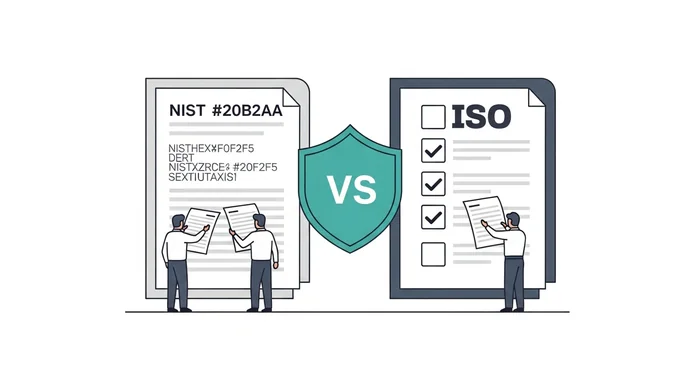
Security and compliance teams often ask the same question at the start of a program build. Should we anchor on NIST CSF vs ISO 27001? Or run both? They are both respected cybersecurity frameworks. But they serve different purposes.
NIST CSF is a voluntary risk-management framework from the United States. ISO 27001 is an internationally recognized, certifiable management standard. Picking the wrong one early forces expensive rework later.
This guide lays out the NIST CSF vs ISO 27001 comparison in full. It covers origins, structure, control depth, audit expectations, cost, and the real decision criteria. The goal is to help startup founders, SMB owners, and security consultants advising small businesses choose well in 2026.
Should a startup choose NIST CSF or ISO 27001 first? For most startups and small businesses selling to U.S. buyers, NIST CSF is the faster, cheaper starting point. Move to ISO 27001 only when an enterprise customer, EU buyer, or agency contract specifically requires the certificate.
Can a founder run a NIST CSF self-assessment without a consultant? Yes. A technical founder or security-aware operator can finish a NIST CSF 2.0 current-state profile in 2 to 4 weeks. The free NIST tooling is enough. ISO 27001 almost always needs an external consultant or experienced internal lead.
NIST CSF vs ISO 27001 at a Glance
Before going deep, here is a quick side-by-side summary of the two frameworks:
| Attribute | NIST CSF 2.0 | ISO 27001:2022 |
|---|---|---|
| Publisher | U.S. National Institute of Standards and Technology | International Organization for Standardization |
| Format | Voluntary framework | Certifiable management standard |
| Certifiable? | No (self-attestation only) | Yes (third-party certification) |
| Structure | 6 Functions, 22 Categories, 106 Subcategories | ISMS requirements + 93 Annex A controls |
| Primary use case | Risk prioritization and communication | Security management system certification |
| Typical audit | Internal or consulting-led gap assessment | External Stage 1 + Stage 2 audit by accredited body |
| Cost range | $10K to $75K (consulting) | $40K to $250K+ (implementation + certification) |
| Geographic reach | Strongest in North America | Global, especially in EU, UK, Asia-Pacific |
| Renewal cycle | Continuous, no formal recertification | 3-year cycle with annual surveillance audits |
| Typical time to adopt | 3 to 6 months | 6 to 18 months |
Data reflects NIST Cybersecurity Framework 2.0, published in February 2024, and the ISO/IEC 27001:2022 revision.
What Is NIST CSF?

The NIST Cybersecurity Framework is a voluntary framework originally developed in 2014 for U.S. critical infrastructure operators and expanded to 2.0 in 2024. The update (known as NIST CSF 2.0) broadened the framework's audience from critical infrastructure to organizations of every size and sector.
NIST CSF 2.0 organizes cybersecurity into six Core Functions:
- Govern (new in 2.0): Establish and monitor the organization's cybersecurity risk management strategy, expectations, and policy
- Identify: Understand assets, business environment, governance, risks, and risk management strategy
- Protect: Implement safeguards to limit or contain the impact of cybersecurity events
- Detect: Identify the occurrence of a cybersecurity event through continuous monitoring
- Respond: Take action regarding a detected cybersecurity incident
- Recover: Maintain plans for resilience and restore capabilities impaired by events
Each Function breaks into Categories and Subcategories that map to specific security outcomes. NIST CSF does not prescribe technical controls directly. Instead, it references other documents like NIST SP 800-53 and ISO 27002 as "informative references" that help organizations implement each Subcategory.
NIST CSF 2.0 Implementation Tiers
NIST CSF uses four Implementation Tiers to describe cybersecurity maturity:
- Tier 1 (Partial): Ad hoc, reactive risk management
- Tier 2 (Risk Informed): Risk management practices approved by management but not formally documented
- Tier 3 (Repeatable): Formal risk management policies, documented and repeatable
- Tier 4 (Adaptive): Continuous improvement based on lessons learned and predictive indicators
Most organizations target Tier 3 for production environments.
What Is ISO 27001?
ISO 27001 is the international standard for an Information Security Management System (ISMS). Published by the International Organization for Standardization and the International Electrotechnical Commission, it is the only internationally recognized cybersecurity standard that an organization can formally certify against.
ISO 27001 is built around two parts:
- ISMS requirements (Clauses 4 to 10): Non-negotiable management system requirements covering context, leadership, planning, support, operation, performance evaluation, and improvement
- Annex A (93 controls): A reference set of security controls organized into four themes: Organizational, People, Physical, and Technological
The 2022 revision reduced the original 114 Annex A controls to 93 and reorganized them into four themes. The clause-level ISMS requirements remained structurally similar.
Organizations earn the ISO 27001 certificate through a two-stage audit. Stage 1 is a documentation review. Stage 2 is an on-site evidence review. An accredited certification body runs both stages. The certificate stays valid for three years, with annual surveillance audits in between.
NIST CSF vs ISO 27001: Structure and Depth
The most practical difference between the two frameworks is how deep they go into prescriptive requirements.
NIST CSF describes security outcomes ("Asset management processes are identified and managed"). ISO 27001 requires the outcome plus documentation, an assigned owner, a measurable target, and evidence that the control is operating effectively over time. An ISO 27001 audit demands actual proof for every applicable Annex A control.
In practice:
- NIST CSF is a menu of security outcomes you can adopt at your own pace
- ISO 27001 is a full management system you must build, operate, document, and prove
A mature organization can complete a NIST CSF self-assessment in a few weeks. A first-time ISO 27001 certification typically takes 9 to 14 months including implementation, internal audit, and the two-stage external audit.
Control Overlap: NIST CSF vs ISO 27001

The two frameworks cover much of the same ground but from different angles. NIST itself publishes an Informative Reference mapping between CSF Subcategories and ISO 27001 Annex A controls.
Typical overlap areas (applicable controls in both frameworks):
| Control area | NIST CSF Function | ISO 27001 Annex A |
|---|---|---|
| Asset management | Identify (ID.AM) | 5.9 Inventory of information and other associated assets |
| Access control | Protect (PR.AA) | 5.15, 5.16, 5.17, 5.18 (Access controls) |
| Awareness and training | Protect (PR.AT) | 6.3 Information security awareness, education, training |
| Vulnerability management | Identify (ID.RA) | 8.8 Management of technical vulnerabilities |
| Incident response | Respond (RS.MA) | 5.24, 5.25, 5.26, 5.27 (Incident management) |
| Business continuity | Recover (RC.RP) | 5.29, 5.30 (ICT readiness for business continuity) |
| Supplier relationships | Govern (GV.SC) | 5.19 to 5.23 (Supplier security) |
Roughly 70 to 80 percent of ISO 27001 Annex A controls have a corresponding NIST CSF Subcategory, though the inverse is less clean because CSF's Govern Function expects outcomes that ISO 27001 scatters across clauses rather than Annex A.
NIST CSF vs ISO 27001: Cost
Cost is where the two frameworks diverge most dramatically.
NIST CSF Cost
A NIST CSF implementation has no certification body fees because no certification exists. Typical spending includes:
- Gap assessment by a consultancy: $10K to $40K
- Remediation of prioritized gaps: variable, driven by technical debt
- Optional NIST CSF profile development: $5K to $20K
- Annual re-assessment: $10K to $30K
Total first-year spend for a mid-market company: typically $25K to $75K.
ISO 27001 Cost
ISO 27001 includes implementation, internal preparation, and external audit fees:
- Gap assessment and policy development: $15K to $50K
- Tooling (GRC platform, risk register, evidence management): $10K to $60K annually
- Internal audit: $5K to $15K
- Stage 1 and Stage 2 external audits: $15K to $40K
- Annual surveillance audits (years 2 and 3): $8K to $20K per year
Total first-year spend for a mid-market company: typically $60K to $250K. Our full ISO 27001 certification cost breakdown covers company-size ranges in detail.
When to Choose NIST CSF
NIST CSF is the right primary framework when one or more of these apply:
- You are a U.S. organization selling primarily to U.S. buyers
- Your customers do not contractually require a formal certification
- You need a common vocabulary to align security, risk, legal, and executive teams
- You want to prioritize security investments without a rigid compliance deadline
- You need to meet a government contract requirement that references NIST (DoD, federal civilian, state government)
- You are early-stage and want a scalable baseline before pursuing full certification
Plenty of startups and small businesses use NIST CSF for the first 12 to 24 months. Then they layer ISO 27001 on top once enterprise customers start demanding it. A solo founder or bootstrap agency can reach a respectable NIST CSF maturity tier with internal effort alone.
When to Choose ISO 27001

ISO 27001 is the right primary framework when:
- You sell to EU, UK, APAC, or multinational enterprises that require a certificate
- Your sales cycle regularly includes a vendor security questionnaire that asks for ISO 27001
- You have legal or contractual obligations that name ISO 27001 explicitly
- You want a durable, independently verified proof of your security management system
- You need to demonstrate ongoing improvement through annual surveillance audits
- You operate in regulated sectors (finance, healthcare, critical infrastructure) in jurisdictions where ISO 27001 is the de facto standard
ISO 27001 is also the better fit when your security program is already mature. It gives you independent, third-party validation that a certificate alone provides.
Can You Use NIST CSF and ISO 27001 Together?
Yes, and many organizations do. The most common approach:
- Use NIST CSF as the strategic framework that communicates risk posture to executives, boards, and U.S. regulators
- Use ISO 27001 as the operational management system that governs day-to-day security, documentation, and audit evidence
The frameworks overlap heavily at the control level. An organization already ISO 27001 certified can produce a NIST CSF profile with minimal extra effort. Going the other way is harder. NIST CSF first, then ISO 27001 later means catching up on structured documentation, management reviews, and audit artifacts that NIST CSF does not require.
Does your organization also need SOC 2, NIST CSF, or PCI DSS? The ISO 27001 vs SOC 2 vs NIST comparison covers the three-way decision.
NIST CSF vs ISO 27001: Audit Process
The audit experience is completely different between the two frameworks.
NIST CSF Audit
- No formal audit requirement
- Most organizations engage a consultancy for an annual gap assessment
- Results typically produced as a heat map, a current-state profile, a target-state profile, and a roadmap
- No certificate, no external validation of findings
- Outputs are useful internally but carry limited weight with external customers
ISO 27001 Audit
- Formal Stage 1 (documentation) and Stage 2 (implementation evidence) audits by an accredited certification body
- Stage 2 audit inspects live evidence for every applicable Annex A control
- Nonconformities must be closed before certification is granted
- Annual surveillance audits in years 2 and 3
- Full recertification audit every three years
- External certificate valid for three years and recognized globally
The difference in external credibility is substantial. An ISO 27001 certificate is the document most frequently requested in global enterprise vendor-risk questionnaires.
NIST CSF vs ISO 27001: What Auditors Actually Look For
A senior auditor's working list for each framework looks different.
For NIST CSF 2.0, an assessor typically:
- Reviews each Subcategory and scores the organization's current maturity tier
- Samples policies and procedures for alignment with the stated outcomes
- Interviews the CISO, CIO, risk owners, and key control owners
- Produces a current-state heat map and a target-state recommendation
For ISO 27001, a certification auditor:
- Verifies the ISMS scope, Statement of Applicability, and risk treatment plan
- Samples evidence for each applicable Annex A control
- Confirms internal audit findings have been addressed
- Tests management review and continual improvement processes
- Issues nonconformities (minor or major) that must be corrected before certification
Has your team ever been through a formal audit? If not, ISO 27001 is a step change in rigor. NIST CSF self-assessment is far lighter by comparison.
NIST CSF vs ISO 27001: Common Mistakes
Teams choosing between these frameworks often make the same mistakes. Avoid these:
- Choosing ISO 27001 when no customer is actually asking for it. The cost and time investment do not pay off without a sales or regulatory trigger.
- Assuming NIST CSF will satisfy enterprise buyers. Large enterprises in the EU and UK typically require a certificate, not a self-assessed profile.
- Adopting both frameworks in parallel from scratch. The overlap is real but the documentation and audit demands of ISO 27001 are enough of a lift on their own.
- Treating NIST CSF as a compliance checkbox. The framework is designed to drive continuous improvement, not to sit on a shelf.
- Ignoring NIST CSF 2.0's Govern Function. The new Function has raised the bar on supply chain and executive-level oversight in ways that catch teams off guard.
Frequently Asked Questions
Is NIST CSF a replacement for ISO 27001? No. NIST CSF is a voluntary framework for organizing and communicating cybersecurity risk. ISO 27001 is a certifiable management standard. They can coexist, and mature programs at startups and SMBs often use both.
Does NIST CSF require third-party certification? No. NIST CSF is self-attested. There is no official NIST CSF certification, although some consulting firms market their own attestations for founder-led small business programs.
Is ISO 27001 required for federal U.S. contracts? No. U.S. federal contracts more often reference NIST publications like NIST SP 800-53, NIST SP 800-171, or NIST CSF. ISO 27001 is occasionally accepted as evidence but is rarely mandatory for federal work.
How long does NIST CSF vs ISO 27001 take to implement? A NIST CSF baseline profile can be delivered in 3 to 6 months. An ISO 27001 certification from scratch typically takes 9 to 14 months, depending on starting maturity and whether you have an internal lead or a consultant.
Which is more respected in the EU and UK? ISO 27001, clearly. ISO 27001 is the dominant cybersecurity certification in European and UK procurement processes.
Can NIST CSF evidence support an ISO 27001 audit? Partially. NIST CSF outcomes map well to ISO 27001 Annex A controls. But ISO 27001 also requires management-system documentation. That includes policies, scope, a Statement of Applicability, and internal audit results. NIST CSF does not demand that layer.
Bottom Line
Start with NIST CSF if you sell to U.S. buyers. Same call if you operate in critical infrastructure. Same call if you need shared language for cyber risk across teams. Go directly to ISO 27001 if you sell to global enterprises. Also go direct if your sector treats the certificate as the cost of doing business. If both apply, use NIST CSF to frame strategy and ISO 27001 to build, run, and certify the management system underneath.
The frameworks are not rivals. They solve different problems. Pick the one that matches the problem you actually have, and keep the other on the shelf until it is the right moment to add it.