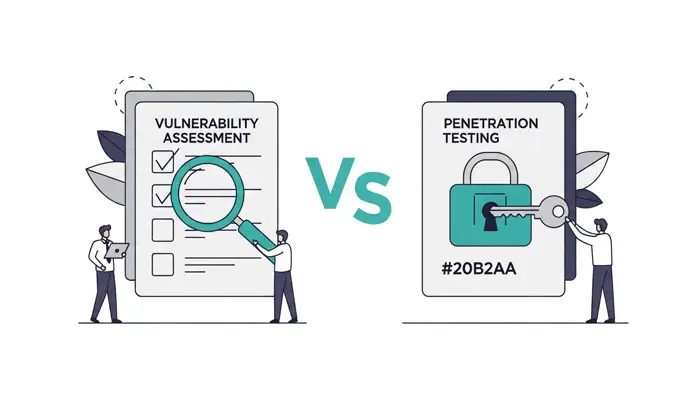
Penetration Testing vs Vulnerability Assessment
Penetration testing and vulnerability assessments serve different purposes in your cybersecurity program, and startups and small businesses often confuse them. A vulnerability assessment scans broadly for known weaknesses, while a penetration test proves whether those weaknesses can be exploited. Understanding this distinction helps you allocate budgets and meet requirements from SOC 2, PCI DSS, HIPAA, and ISO 27001.
What Is a Vulnerability Assessment?
A vulnerability assessment identifies, quantifies, and prioritizes security weaknesses across your IT environment using automated scanning tools. Scanners like Nessus, Qualys, and Rapid7 InsightVM check for missing patches, misconfigurations, and outdated software against CVE databases.
The typical process follows six steps:
- Define which systems and networks to scan
- Discover all assets, open ports, and running services
- Run automated vulnerability scans
- Analyze results and remove false positives
- Rank findings by CVSS severity and business impact
- Document findings with remediation steps
Common findings include missing OS patches, weak passwords, open ports, SSL/TLS certificate issues, misconfigured firewalls, and insecure protocols like Telnet or FTP. For startups and SMBs, quarterly scans typically cost $2,000 to $15,000 depending on scope. Enterprise licenses for tools like Nessus Professional start at approximately $3,990 per year, while Qualys and Rapid7 offer cloud-based scanning from around $2,000 per year for small environments.
What Is Penetration Testing?

Penetration testing is a simulated cyberattack by skilled security professionals who actively exploit vulnerabilities in your systems. While assessments identify weaknesses, pen tests prove what an attacker could actually achieve, including data theft, privilege escalation, and lateral movement.
Testers follow established methodologies like OWASP Testing Guide, PTES, or NIST SP 800-115. The process includes:
- Planning and reconnaissance (define scope, gather intelligence)
- Scanning and enumeration (identify attack surfaces)
- Active exploitation (attempt to breach systems)
- Post-exploitation (lateral movement, privilege escalation, data access)
- Reporting (document attack chains, business impact, remediation)
- Retesting (verify fixes close the gaps)
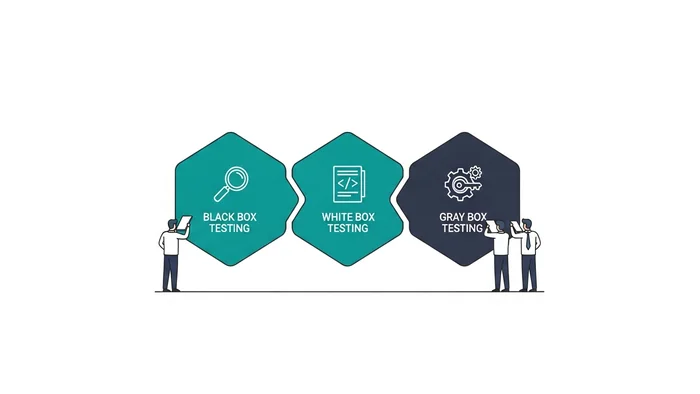
Organizations choose between black box (no prior knowledge, simulating external attackers), white box (full access to source code and architecture), and gray box (partial knowledge like user credentials) testing. Each serves different objectives. A typical engagement costs $10,000 to $100,000+ and takes days to weeks.
Key Differences at a Glance
| Factor | Vulnerability Assessment | Penetration Testing |
|---|---|---|
| Approach | Automated scanning | Manual expert testing |
| Depth | Broad but shallow | Narrow but deep |
| Goal | Catalog all known weaknesses | Prove exploitability and impact |
| Duration | Hours to days | Days to weeks |
| Cost | $2,000 to $15,000 | $10,000 to $100,000+ |
| Frequency | Monthly or quarterly | Annually or after major changes |
| False positives | Higher (automated, lacks context) | Lower (human verification) |
| Risk to systems | Minimal (non-invasive) | Some risk (active exploitation) |
The most important distinction: vulnerability assessments tell you what could go wrong. Penetration tests tell you what will go wrong. According to the SANS Institute, 78% of organizations with mature security programs run both testing types regularly.
When to Use Each
Choose a vulnerability assessment when you need a baseline inventory of security weaknesses, your compliance framework requires regular scanning (like PCI DSS Requirement 11.2), you want to verify patch management effectiveness, or your startup is between annual penetration tests and needs continuous visibility.
Choose a penetration test when you must validate whether vulnerabilities are actually exploitable, compliance mandates it (PCI DSS Requirement 11.3, SOC 2), you experienced a security incident and need to assess exposure, major infrastructure changed (cloud migration, merger, new application), or executive leadership needs a realistic picture of breach risk.
Choose both when your startup or SMB is pursuing SOC 2, PCI DSS, or ISO 27001 certification, handling sensitive data (healthcare, financial, government), or building a mature security testing program. Most compliance frameworks expect evidence of both testing types.
For small businesses on tight budgets, consider starting with quarterly vulnerability assessments using affordable tools like OpenVAS (free and open source) or Nessus Essentials (free for up to 16 IPs). As revenue grows and compliance requirements expand, add annual penetration testing from a qualified firm. This progressive approach builds security maturity without overwhelming early-stage budgets.
Compliance Requirements by Framework

Different frameworks have specific testing requirements that startups must understand.
PCI DSS 4.0 has the most explicit mandates: quarterly internal vulnerability scans (Req 11.3.1), quarterly external scans by an Approved Scanning Vendor (Req 11.3.2), and annual internal and external penetration testing (Req 11.4.1-11.4.2). PCI DSS 4.0 also requires that internal scans address all high-risk and critical vulnerabilities through verified rescans.
SOC 2 does not prescribe specific intervals, but Trust Service Criteria CC7.1 and CC4.1 require vulnerability detection and remediation. Most auditors expect annual pen testing and quarterly vulnerability scans as evidence.
ISO 27001:2022 Annex A.8.8 requires timely identification and remediation of technical vulnerabilities. The standard does not mandate specific test types but requires documented vulnerability management processes.
HIPAA Security Rule section 164.308(a)(8) requires periodic technical evaluation. HHS guidance recommends both vulnerability scanning and penetration testing as part of risk analysis.
Building a Combined Testing Program
For startups and SMBs building a practical annual program, follow this calendar:
- Q1: Annual penetration test plus vulnerability scan (comprehensive baseline)
- Q2: Vulnerability scan plus remediation verification (patch validation)
- Q3: Vulnerability scan plus targeted pen test if major changes occurred
- Q4: Vulnerability scan plus pre-audit preparation (compliance readiness)
Set remediation SLAs by severity: critical within 48 hours, high within 7 days, medium within 30 days. Track mean time to remediate and vulnerability density trends. Tools like Vanta, Drata, or Secureframe can automate evidence collection for both testing types, reducing documentation burden by up to 80%.
When selecting a penetration testing company, verify OSCP, GPEN, or CREST certifications. Request sample reports and client references in your industry. Ensure the firm follows PTES, OWASP, or NIST SP 800-115 methodologies and carries professional liability insurance.
Choosing a Pen Testing Firm
When selecting a pen testing provider for your startup or SMB, evaluate these factors:
- Certifications: Require OSCP, GPEN, or CREST credentials from the actual testers (not just the firm)
- Methodology: Confirm they follow PTES, OWASP, or NIST SP 800-115
- Industry experience: Ask for references from companies in your sector (healthcare, fintech, SaaS)
- Insurance: Verify professional liability coverage in case testing causes unexpected downtime
- Reporting quality: Request sample reports to evaluate depth and actionability of findings
- Retesting: Confirm the engagement includes verification that remediation efforts close identified gaps
The average cost of a data breach in 2024 reached $4.88 million according to IBM's Cost of a Data Breach Report. Even a basic annual pen test at $15,000 to $25,000 is a fraction of that exposure. For startups handling sensitive data, pen testing is not optional. It is table stakes for building trust with enterprise clients and meeting compliance requirements.
Red team engagements, which combine penetration testing with social engineering and physical security testing, cost $40,000 to $150,000 but provide the most realistic picture of organizational security posture. For most startups and small businesses, a standard gray box penetration test offers the best balance of coverage and cost.
Frequently Asked Questions
Q: Can a vulnerability assessment replace a penetration test? A: No. Assessments use automated tools to find known weaknesses but cannot prove exploitability or demonstrate attack chains. Pen tests require human expertise to chain vulnerabilities and bypass defenses. Most compliance frameworks require both types of testing.
Q: How often should I run vulnerability assessments? A: Most frameworks require quarterly scans at minimum. PCI DSS mandates quarterly internal and external scans. For cloud-native startups with frequent deployments, monthly or continuous scanning is recommended to catch new vulnerabilities quickly.
Q: Is penetration testing required for SOC 2? A: SOC 2 does not explicitly mandate it, but nearly all auditors expect annual pen testing as evidence of Trust Service Criteria CC7.1. Annual penetration testing has become a de facto requirement for SOC 2 Type 2 reports.
Q: What certifications should a pen testing firm have? A: Look for OSCP (Offensive Security Certified Professional), GPEN (GIAC Penetration Tester), or CREST certifications. The firm should follow PTES, OWASP, or NIST SP 800-115 methodologies. Ask for sample reports and client references in your industry.
Q: What is the difference between a vulnerability scan and a vulnerability assessment? A: A scan is the automated tool component that identifies known vulnerabilities. An assessment adds human analysis, false positive validation, risk prioritization, and remediation guidance. The assessment provides business context that raw scan data lacks.
Primary Sources

This article references the following authoritative sources:
- NIST Cybersecurity Framework, NIST Cybersecurity Framework 2.0
- NIST SP 800-53, NIST SP 800-53 Rev 5
- NIST SP 800-171, NIST SP 800-171 Rev 3 (Controlled Unclassified Information)