
GRC Software: The 2026 Complete Buyer's Guide
GRC software is the category of platforms that centralizes governance, risk, and compliance work in one place. It replaces spreadsheets, shared drives, and email threads with a system of record for controls, policies, evidence, risks, vendors, and audit findings.
This guide is written for security leads, compliance directors, founders preparing for their first SOC 2, and risk officers at companies past 500 employees. It assumes you already know you need a tool. The job here is helping you pick the right kind.
The category is messy. A startup buying "GRC software" to pass SOC 2 ends up looking at very different products than a Fortune 500 bank buying "GRC software" for operational risk. They are not the same market, and treating them as one is the most common reason buyers regret their pick by year two. This article splits the category into the three groups that actually exist in 2026, maps each group to the frameworks and company stages it serves, lists the costs, and walks through a decision tree you can apply in an afternoon.
For head-to-head comparisons, see Vanta vs Drata vs Secureframe, Sprinto vs Vanta, and the Vanta review. For a ranked list of compliance-focused tools, see best GRC software platforms. For the operational workflow these tools accelerate, see the compliance automation guide.
What GRC software is, and what it isn't
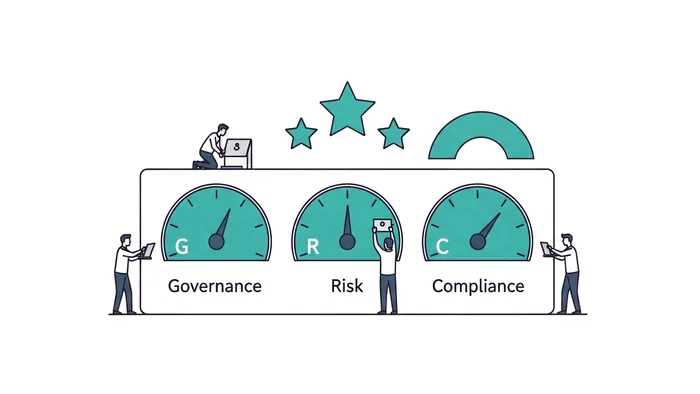
GRC stands for governance, risk, and compliance. Each word maps to a discipline that existed long before the software did. Governance is the structure of policies, accountability, and board oversight. Risk is the identification, scoring, and mitigation of things that could hurt the business. Compliance is the demonstration that you meet specific frameworks, regulations, or contractual obligations.
A GRC platform is a system of record that holds the artifacts of all three disciplines and connects them. The control that mitigates a risk is the same control that satisfies a compliance requirement. The policy that documents the control is the same policy the auditor asks for. The evidence that proves the control ran is the same evidence the board wants to see. GRC software exists to keep these artifacts in one place and stop them from drifting.
A GRC platform is not a security tool. It does not block attacks, monitor traffic, or scan code. It tells you whether your organization is operating the controls it claims to operate, and produces the paperwork needed to prove it. It is also not a substitute for a security program. A clean SOC 2 report from a well-run Vanta instance means very little if the underlying controls are weak. The software automates the bookkeeping. The controls still have to work.
Who GRC software is for

Three buyer profiles dominate the market in 2026:
The startup or growth-stage SaaS company buying its first compliance tool because enterprise prospects keep asking for a SOC 2 report. Headcount 20 to 500. Frameworks: SOC 2 Type 2, eventually ISO/IEC 27001, often HIPAA. Buyer: head of security, engineering, or founder. Budget: $10K to $50K per year.
The mid-market or post-IPO company that needs a real internal audit function and a control inventory that survives external scrutiny. Headcount 500 to 5,000. Frameworks: SOC 1, SOC 2, ISO 27001, SOX ITGCs, PCI DSS, and customer-specific mappings. Buyer: Director or VP of Internal Audit, GRC, or Compliance. Budget: $75K to $400K per year.
The enterprise needing integrated risk management across operations, IT, vendors, business continuity, and dozens of regulators in multiple jurisdictions. Headcount 5,000+. Frameworks: all of the above plus NIST SP 800-53, FedRAMP, GLBA, NYDFS 23 NYCRR 500, DORA, and industry-specific regulations. Buyer: CISO, Chief Risk Officer, or Chief Compliance Officer. Budget: $300K to $2M+ per year.
These three profiles map to three different software categories, and that mapping is the most important decision in this purchase.
The three categories of GRC software
The marketing materials of every GRC vendor blur category lines. The product capabilities do not. Here is the breakdown that holds in 2026.
| Category | What it does best | Representative vendors | Typical buyer | Annual cost band |
|---|---|---|---|---|
| Compliance automation platforms | Automate SOC 2, ISO 27001, HIPAA, PCI DSS for cloud-native companies. Connect to AWS, Okta, GitHub. Pull evidence continuously. Guide audits. | Vanta, Drata, Secureframe, Sprinto, Strike Graph, Hyperproof | Startup and mid-market SaaS, 20 to 1,500 employees | $10K to $75K |
| GRC platforms | Control libraries across many frameworks, risk registers, internal audit workflows, policy management, SOX testing, multi-entity rollups. | AuditBoard, Workiva, LogicGate, Hyperproof, Galvanize (Diligent) | Mid-market to large enterprise, 500 to 10,000 employees | $75K to $400K |
| Integrated risk management (IRM) platforms | Operational risk, IT risk, third-party risk, business continuity, enterprise risk, regulatory change management at scale and across business units. | ServiceNow GRC, OneTrust, MetricStream, RSA Archer, Riskonnect | Enterprise and regulated industries, 5,000+ employees | $300K to $2M+ |
Compliance automation platforms
Vanta, Drata, and Secureframe are the category leaders, with Sprinto, Strike Graph, and Hyperproof rounding out the field. They share a common architecture: deep integrations into cloud and SaaS tools, automated evidence collection, pre-built control libraries mapped to common frameworks, and a guided audit workflow that ends with a clean SOC 2 or ISO 27001 report.
The frameworks these tools cover well are the ones a cloud-native company actually needs in years one through three. The AICPA Trust Services Criteria underpin SOC 2, and every platform in this category supports them. ISO/IEC 27001:2022 and its Annex A controls are universally covered. HIPAA Security Rule mappings, PCI DSS v4.0, GDPR, and CCPA are standard. NIST 800-53 and CMMC are supported by most. FedRAMP Tailored or Low-Impact SaaS is supported by some, with Vanta the most invested. The FedRAMP marketplace lists authorized service providers and the underlying NIST 800-53 baseline the program enforces.
What these platforms do poorly is anything outside the cloud-native SaaS pattern. Heavy on-prem environments, multi-entity consolidated risk reporting, integrated business continuity, and operational risk at financial-services scale are not their strengths. For head-to-head economics within this group, see Vanta vs Drata vs Secureframe and Sprinto vs Vanta.
GRC platforms
The middle tier. AuditBoard, Workiva, LogicGate, and Hyperproof dominate. Buyers are internal audit, SOX, or GRC teams at companies between 500 and 10,000 employees, often public, often regulated, usually running more than one framework.
The capabilities that matter here are the ones compliance automation platforms do not prioritize: multi-entity control rollups for subsidiaries, SOX ITGC testing tied to financial statement audits, internal audit workflow with planning and fieldwork, policy lifecycle management with review cycles and attestations, risk registers that quantify and aggregate exposure across business units, and vendor risk assessment beyond simple SOC 2 report requests.
These platforms typically map controls to dozens of frameworks, including NIST SP 800-53, ISO 27001 Annex A, COSO, COBIT, NIST Cybersecurity Framework, and industry-specific frameworks like HITRUST for healthcare or NERC CIP for utilities. They also handle SSAE 18 SOC 1 attestations, which the compliance automation platforms generally do not. Tugboat Logic used to sit on the seam between this tier and the compliance automation tier; OneTrust acquired it in 2021 and folded it into OneTrust Certification Automation, pulling the product decisively into the IRM tier described next.
Integrated risk management (IRM) platforms
The enterprise tier. ServiceNow GRC, OneTrust, MetricStream, RSA Archer (now a standalone company), and Riskonnect operate at the top of the market. The buying motion is a multi-year, six-or-seven-figure platform decision, often tied to a broader enterprise architecture initiative.
These platforms treat risk as a horizontal function. Operational, IT, cyber, vendor, business continuity, and regulatory compliance share underlying data: controls, policies, processes, business units, and risks. ServiceNow GRC, for example, sits on the broader ServiceNow platform and pulls operational data directly from IT service management, asset management, and HR.
The framework universe at this tier is effectively unlimited: NIST 800-53, ISO 27001, ISO 27002, ISO 31000, the ISO management system standards family, SOX, COSO ERM, BCBS 239, DORA, NYDFS 23 NYCRR 500, and dozens more. Custom framework authoring is standard.
The cost reflects the scope. Six-figure annual contracts are entry points; seven figures is normal for global enterprises. Implementation timelines run 6 to 18 months and typically involve external systems integrators. For the cloud security posture layer that often feeds into IRM platforms, see best CSPM tools.
Framework coverage in practice
The frameworks GRC software targets fall into a handful of families. Every serious platform covers some subset. The question is which.
SOC 2 (and SOC 1, SOC 3). Built on the AICPA Trust Services Criteria for security, availability, processing integrity, confidentiality, and privacy. SSAE 18 is the underlying attestation standard the AICPA publishes. Universally supported by compliance automation platforms. SOC 1 (financial reporting controls) is more often handled in GRC and IRM tier platforms.
ISO/IEC 27001. The ISO/IEC 27001:2022 information security management system standard, with its 93 Annex A controls drawn from ISO/IEC 27002:2022. The 2022 update reduced control count from 114 to 93 and reorganized them into four themes (organizational, people, physical, technological). Confirm any platform you evaluate is current with the 2022 control set, not the 2013 set.
HIPAA. The HHS Office for Civil Rights enforces the Security Rule and Privacy Rule for covered entities and business associates. The HHS HIPAA portal lists the rule text and enforcement actions. GRC platforms map controls to the Security Rule's administrative, physical, and technical safeguards.
PCI DSS. Maintained by the PCI Security Standards Council. PCI DSS v4.0 is the current version, with v4.0.1 the active errata. Compliance automation platforms support self-assessment questionnaires; GRC platforms add fuller scoping and Report on Compliance workflows.
NIST SP 800-53. The NIST SP 800-53 Revision 5 control catalog is the foundation for U.S. federal information systems and the baseline behind FedRAMP. Depth varies: a compliance automation platform may map the 200-plus baseline controls; an IRM platform handles the full 1,000+ control catalog with parameter customization.
FedRAMP. The FedRAMP program authorizes cloud service providers for federal use, based on NIST 800-53. Pursuing FedRAMP authorization narrows the platform field substantially. Vanta is the most invested compliance automation vendor in FedRAMP Tailored and Low-Impact SaaS. Full Moderate and High authorizations almost always pull buyers into the GRC or IRM tiers.
SOX ITGCs. Section 404 of Sarbanes-Oxley drives a controls regime for public companies that almost universally runs on a GRC tier platform. AuditBoard, Workiva, and LogicGate dominate the post-IPO mid-cap segment. The compliance automation tier can support SOX ITGC mapping but is rarely a complete fit at scale.
Privacy frameworks. GDPR, CCPA, the EU AI Act, India's DPDP Act, and a growing list of state and national privacy laws. OneTrust is the category leader for privacy-specific workflows; most other GRC platforms support privacy control mappings but defer the operational privacy workflow (consent, DSRs, ROPA) to dedicated tools.
For the workflow these frameworks share, see the compliance automation guide, and for ISO 27001 program planning, the ISO 27001 certification guide.
Pricing tiers and what drives them

GRC software pricing is quote-based across the entire category. Published "starting at" numbers are entry points, not typical contract values. Here is the realistic spend by tier in 2026.
Compliance automation tier. Entry pricing for a single framework at a sub-50-employee company starts around $8,000 to $12,000 per year across the four major vendors. A growth-stage SaaS at 100 to 300 employees with two frameworks typically spends $20,000 to $50,000. Enterprise SaaS at 1,000 employees with three or more frameworks reaches $75,000 to $150,000. Add-ons that change the number meaningfully: vendor risk management modules, trust centers, AI questionnaire automation, additional workspaces for multi-product companies, and premium support tiers.
GRC tier. Workiva, AuditBoard, and LogicGate typically land between $75,000 and $250,000 for a mid-market deployment, with $400,000 to $600,000 normal for larger public companies running SOX, internal audit, and ERM modules on one platform. Hyperproof tends to anchor the lower end of this tier and overlaps with the upper end of the compliance automation tier.
IRM tier. ServiceNow GRC, OneTrust, and MetricStream rarely come in below $300,000 per year and routinely run $750,000 to $1.5M+ for global deployments. Implementation costs are separate and typically equal or exceed the first-year license fee. Expect a 6 to 12-month implementation with a systems integrator.
Cost drivers within each tier are roughly identical: headcount, number of frameworks, number of integrations, number of business units or legal entities, premium modules (vendor risk, AI questionnaires, trust center), and the level of professional services purchased at the start. The variable that surprises buyers most often is "workspaces" or "instances" for multi-product or multi-subsidiary companies. Confirm the model up front.
The buying decision tree by company stage
Different stages have different right answers. The table below is the same logic an experienced GRC consultant would walk you through.
| Company stage and trigger | Right category | Shortlist to evaluate | Why |
|---|---|---|---|
| Seed to Series A SaaS, first SOC 2 to close enterprise deals | Compliance automation | Vanta, Drata, Secureframe, Sprinto | You need speed, low cost, and a clear audit path. Anything heavier slows you down. |
| Series B to Series D SaaS, adding ISO 27001, HIPAA, or PCI DSS | Compliance automation | Vanta, Drata, Secureframe, Hyperproof | Multi-framework mapping matters now. Hyperproof and Drata tend to handle it most cleanly. |
| Mid-market SaaS pursuing FedRAMP Tailored or LI-SaaS | Compliance automation | Vanta (with FedRAMP partner auditors) | Vanta has the deepest FedRAMP Tailored tooling among compliance automation vendors. |
| Post-IPO mid-cap, first SOX year, also running SOC 2 and ISO 27001 | GRC platform | AuditBoard, Workiva, LogicGate | SOX ITGCs, internal audit workflow, and multi-framework control libraries belong in this tier. |
| 500 to 5,000 employees, formal internal audit function, multiple legal entities | GRC platform | AuditBoard, Workiva, LogicGate, Hyperproof | Internal audit, policy management, and entity rollups are the differentiators here. |
| Regulated healthcare or fintech at 1,000+ employees | GRC platform, optionally IRM | AuditBoard, LogicGate, OneTrust | Privacy workflows push toward OneTrust; SOX and audit push toward AuditBoard or LogicGate. |
| Global enterprise with operational risk, IT risk, vendor risk, and business continuity | IRM platform | ServiceNow GRC, MetricStream, OneTrust, Riskonnect | You need one canvas across many risk disciplines. Only IRM platforms deliver this. |
| Bank or insurer subject to BCBS 239, DORA, NYDFS 23 NYCRR 500 | IRM platform | MetricStream, ServiceNow GRC, RSA Archer | Regulatory change management and risk data aggregation are core to these products. |
Two practical notes on running this decision tree.
First, do not over-buy. The single most common GRC software mistake is a Series B SaaS company being talked into a six-figure GRC tier contract when a compliance automation platform would have served them better for years. The reverse mistake also happens: a post-IPO company tries to extend a compliance automation tool into SOX testing and discovers at year-end that the auditor cannot work with the evidence package format.
Second, validate auditor fit before signing. Compliance automation platforms have partner auditor networks (Vanta, Drata, and Secureframe each list dozens of firms), and using an in-network auditor materially smooths the first audit cycle. GRC tier platforms are typically auditor-agnostic but still benefit from your audit firm having seen the platform before. Confirm during the sales cycle.
Common selection mistakes
Five patterns repeat in regretted GRC purchases.
Buying for today's framework, not the one you will have in 18 months. A company that buys a SOC 2-only tool and then adds HIPAA, ISO 27001, and PCI DSS within a year rebuilds evidence flows multiple times. Pick a platform that covers your two-year framework roadmap.
Treating "375 integrations" as a feature. Three integrations pulling rich evidence beat 50 that pull a status flag. Ask vendors to demo evidence collection from the three or four systems that dominate your stack.
Underestimating implementation. Compliance automation: 20 to 40 hours to stand up the first framework. GRC tier: 8 to 16 weeks. IRM tier: 6 to 12 months plus a systems integrator. Build this into the procurement timeline.
Ignoring policy workflows. Most platforms generate or import policies; far fewer handle review cycles, attestations, and version history well. If a board, auditor, or regulator asks for evidence that employees acknowledged the current policy version, this matters.
Confusing trust centers with security programs. Vanta's, Drata's, and OneTrust's trust centers are valuable buyer-facing artifacts. They are not a security program. The work behind the trust center produces the clean report; the trust center just publishes the receipts.
Frequently asked questions

What is the difference between GRC software and a compliance automation platform?
A compliance automation platform is one slice of GRC software, focused on automating evidence collection and audit preparation for common frameworks (SOC 2, ISO 27001, HIPAA, PCI DSS) at cloud-native companies. Broader GRC platforms add internal audit workflow, policy lifecycle, risk registers, multi-entity rollups, and SOX testing. IRM platforms extend further into operational, vendor, business continuity, and regulatory risk. All three are "GRC software"; they serve different buyers.
Do I need GRC software for my first SOC 2 audit?
You can do a first SOC 2 Type 1 without dedicated software. You should not do a SOC 2 Type 2 without it. Type 2 requires evidence across a 6 to 12-month observation window, and assembling that evidence from spreadsheets, screenshots, and email at audit time is where most first-time programs fail. A compliance automation platform pays for itself by the time you start the Type 2 readiness assessment. See the Vanta review for a deeper look at the math.
Is open-source GRC software a real option?
There are open-source projects (Eramba, SimpleRisk, Comp AI) that handle pieces of the GRC workflow, primarily risk registers and policy management. None come close to the integration depth or audit workflow of the commercial tools. They are credible for very small companies with strong internal engineering capacity and tolerance for self-hosting. For most companies, the staff time required to operate open-source GRC software exceeds the license cost of a commercial alternative.
How long does GRC software implementation take?
Compliance automation tier: 4 to 8 weeks to first-audit readiness, plus the audit window itself (6 to 12 months for Type 2). GRC tier: 8 to 16 weeks for a single module, longer for multi-module rollouts. IRM tier: 6 to 12 months minimum, often longer for global enterprises. Implementation time is shorter when the buying team has done it before and has clear control framework decisions made up front.
Can one platform handle SOC 2, ISO 27001, HIPAA, and PCI DSS together?
Yes, and this is one of the strongest arguments for compliance automation platforms. The major vendors map a single control to multiple framework requirements, so adding a second or third framework usually adds 10 to 20% more work, not 100%. Confirm the platform supports your full framework set before signing, and validate the auditor relationship for each framework.
What is the difference between GRC and IRM?
GRC (governance, risk, and compliance) is the older term and tends to refer to platforms organized around compliance frameworks and internal controls. IRM (integrated risk management) is the term Gartner pushed starting around 2017 and emphasizes risk as the organizing concept across operations, IT, vendors, and regulation. In practice, the categories overlap heavily at the high end. The label matters less than whether the platform can serve the breadth of risk disciplines your organization needs.
Should we use the GRC software our auditor recommends?
It is a useful data point, not a deciding factor. Auditors recommend platforms they have worked with successfully. That is a signal of operational fit, especially in the compliance automation tier where partner auditor networks exist. It is not a signal that the platform is the right product for your roadmap. Run the decision tree on your own needs, then check auditor fit at the end of the shortlist.
Bottom line
GRC software is a three-category market: compliance automation for cloud-native SaaS, GRC platforms for mid-market and public companies needing internal audit and SOX, and IRM platforms for global enterprises with horizontal risk management. Pick the category that matches your buyer profile and two-year roadmap before you pick the vendor. Inside each category, integration depth, auditor fit, and price decide. Across categories the products are not interchangeable, and the most expensive mistakes happen when buyers pick the wrong tier.
For the next layer, see best GRC software platforms, Vanta vs Drata vs Secureframe, Sprinto vs Vanta, the Vanta review, the compliance automation guide, and best CSPM tools.
Primary sources
- AICPA SOC 2 reporting framework
- AICPA SSAE 18 attestation standards
- ISO/IEC 27001:2022 information security management
- ISO/IEC 27002:2022 information security controls
- ISO management system standards overview
- NIST SP 800-53 Rev 5 control catalog
- NIST Cybersecurity Framework
- FedRAMP program and marketplace
- PCI Security Standards Council
- HHS HIPAA portal
Last reviewed: 2026-05-12.