Web Application Penetration Testing: A Complete Guide
TL;DR
- A web app pen test is a structured, authorized attempt to exploit real vulnerabilities, not just identify them. It covers authentication, authorization, input validation, business logic, APIs, and configuration.
- The two most referenced methodology standards are the OWASP Web Security Testing Guide v4.2 and the Penetration Testing Execution Standard (PTES). Both structure engagements into pre-engagement, reconnaissance, discovery, exploitation, and reporting phases.
- Gray-box testing (test accounts provided, some architecture context) delivers the best result-to-cost ratio for most organizations because it mirrors the credential-compromise scenario that dominates incident response caseloads (a consistent theme in Verizon DBIR annual reporting).
- PCI DSS v4.0.1 Requirement 11.4 mandates penetration testing at least annually and after any significant change to network architecture, web server software, or application code. SOC 2 and HIPAA expect it as evidence of a functioning risk assessment program.
- Every finding in a credible report maps to an OWASP Top 10:2025 category and carries a CVSS severity score, scored against FIRST's current CVSS v4.0 specification or the still widely used CVSS v3.1, with the report stating which version was used. A report that only lists scanner output without OWASP mapping and manual exploitation evidence is a vulnerability scan, not a pen test.
Who this is for
Security engineers, application developers, and compliance leads at organizations that run customer-facing web applications. Particularly relevant if you are preparing for a PCI DSS, SOC 2, or HIPAA audit and need to understand what "regular technical evaluation of security controls" means in practice, how to scope an engagement, and what a finished report should contain.
What a Web Application Penetration Test Actually Covers
A web application penetration test is a structured, authorized attempt to exploit vulnerabilities in a web-based application. The critical distinction from a vulnerability assessment is exploitation: a tester who only lists potential weaknesses without confirming real-world impact is conducting a vulnerability assessment, not a penetration test. The distinction matters when presenting findings to a board, a compliance auditor, or a development team deciding how to prioritize remediation.
The OWASP Web Security Testing Guide v4.2 organizes the application attack surface across 11 testing domains. A complete engagement covers all of them:
- Information gathering, technology fingerprinting, application mapping, publicly accessible data that reveals the stack or architecture
- Configuration and deployment, exposed admin interfaces, default credentials, directory listing, HTTP method permissiveness, backup file exposure
- Identity management, user enumeration, account provisioning flaws, role definition weaknesses
- Authentication, credential transport, lockout mechanisms, multi-factor bypass, default credential handling
- Authorization, directory traversal, privilege escalation (horizontal and vertical), insecure direct object references
- Session management, cookie attribute validation, session fixation, CSRF protection, timeout and logout behavior, token entropy
- Input validation, reflected and stored XSS, SQL injection and its variants (blind, time-based, out-of-band), LDAP injection, XML external entity, command injection, template injection
- Error handling, stack trace leakage, verbose server responses, unhandled exception disclosure
- Cryptography, TLS version and cipher suite strength, padding oracle conditions, unencrypted sensitive data in transit
- Business logic, rate limiting gaps, workflow bypass, price manipulation, race conditions, malicious file upload
- Client-side, DOM-based XSS, HTML injection, open redirects, CORS misconfiguration, clickjacking, local/session storage exposure
An engagement that skips the business logic and client-side categories should cost less, but also produces less. Flag any scope that excludes those categories before signing the statement of work.
The OWASP Top 10:2025, What Testers Check Against

The OWASP Top 10:2025 is the baseline risk taxonomy for web application security. Any credible pen test report maps findings to these categories. The 2025 edition, OWASP's first update since 2021, keeps Broken Access Control at the top of the list and folds Server-Side Request Forgery into it, replaces Vulnerable and Outdated Components with a broadened Software Supply Chain Failures category covering the wider dependency and build ecosystem, and adds Mishandling of Exceptional Conditions as a new category for error-handling and failure-state defects.
| Code | Category | What Testers Look For |
|---|---|---|
| A01 | Broken Access Control | IDOR via URL parameter manipulation, horizontal privilege escalation, forced browsing to restricted paths, and SSRF-style requests that abuse trusted server-side calls (SSRF was folded into this category in 2025) |
| A02 | Security Misconfiguration | Directory listing enabled, verbose error pages, default framework credentials, overly permissive CORS, cloud storage misconfiguration |
| A03 | Software Supply Chain Failures | Unmaintained or unpatched dependencies, known CVEs in third-party libraries (Log4Shell-class flaws), and compromised build or distribution pipelines |
| A04 | Cryptographic Failures | Passwords stored without salted hashing, PII transmitted over HTTP, weak cipher suites in TLS configuration |
| A05 | Injection | SQL injection in search and filter fields, LDAP injection in directory lookups, XSS in user-generated content output |
| A06 | Insecure Design | Credential recovery workflows that don't meet current standards, business logic that can be abused for financial harm (booking or discount manipulation), missing anti-bot controls |
| A07 | Authentication Failures | Credential stuffing and password spraying, session fixation and identifier reuse, reliance on single-factor authentication with no MFA |
| A08 | Software or Data Integrity Failures | Insecure deserialization of untrusted data, unsigned firmware or software updates, dependencies pulled from unvetted sources |
| A09 | Security Logging and Alerting Failures | No alerting on repeated authentication failures, logs that don't capture user identity or request context, sensitive data written into logs |
| A10 | Mishandling of Exceptional Conditions | Verbose error responses that leak system detail, unhandled exceptions that exhaust resources, missing transaction rollback that lets an attacker corrupt multi-step state |
The OWASP Top 10 is referenced directly in PCI DSS v4.0.1 guidance and aligns with NIST SP 800-115 testing objectives. For organizations with APIs, the separate OWASP API Security Top 10:2023 adds ten categories specific to REST and GraphQL endpoints, including Broken Object Level Authorization (API1), Broken Object Property Level Authorization (API3), and Unrestricted Resource Consumption (API4). Any application with a public or partner-facing API should include API testing in scope.
Methodology: The Seven PTES Phases and OWASP WSTG Alignment
The Penetration Testing Execution Standard organizes an engagement into seven phases. The OWASP WSTG v4.2 maps to similar phases but frames them in a software development lifecycle context. For a time-boxed engagement, PTES is the more practical operational framework.
Phase 1: Pre-engagement
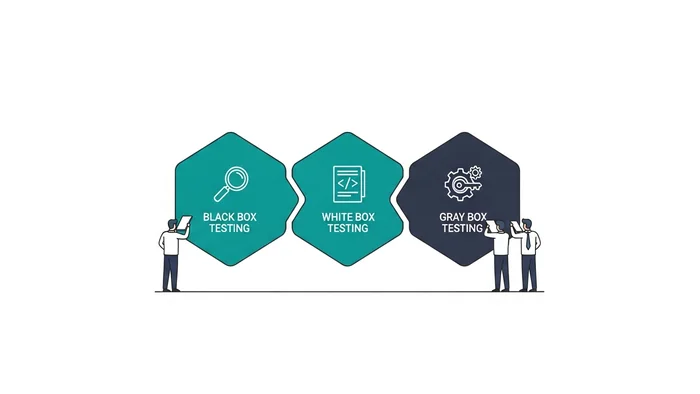
Define scope (every in-scope URL, subdomain, API endpoint, and environment), rules of engagement (can the tester attempt denial-of-service against staging?), emergency contacts, testing windows, and data handling procedures. This phase also establishes whether the test is black-box (no credentials, no documentation), gray-box (test accounts plus partial architecture context), or white-box (source code access, full architecture diagrams, accounts for every user role).
The scope document should be signed before any testing begins. NIST SP 800-115 recommends treating this as a formal agreement that protects both parties from misunderstanding about what constitutes authorized activity.
Phase 2: Intelligence Gathering (Reconnaissance)
The tester maps the application's attack surface without yet probing for vulnerabilities. OWASP WSTG section 4.1 covers this domain, including search engine discovery, web server fingerprinting, application architecture mapping, and analysis of publicly accessible source code or configuration files.
For black-box engagements, this phase can consume a third of the total testing time. For gray-box engagements with provided documentation, it is shorter but still necessary to identify attack surface that may not appear in the documentation.
Phase 3: Threat Modeling
The tester models attack paths relevant to the application's architecture, user base, and data sensitivity. An e-commerce checkout flow has different high-value targets than a healthcare portal or an admin-only internal tool. This phase determines where manual testing effort should concentrate.
Phase 4: Vulnerability Analysis
Using automated tools (Burp Suite Professional, OWASP ZAP, Nuclei) for broad coverage and manual techniques for depth, the tester identifies candidate vulnerabilities. OWASP WSTG sections 4.2 through 4.11 map to 10 of the 11 testing domains listed above (section 4.1, information gathering, is addressed in Phase 2). Automated tools reliably find reflected XSS, missing security headers, outdated component versions, and known CVEs in server software. They do not reliably find business logic flaws, chained attack paths, or authentication bypass through race conditions.
Phase 5: Exploitation
The tester confirms vulnerabilities by exploiting them in a controlled manner. A SQL injection finding is documented with a proof-of-concept query that extracts real (or test) data from the database, not just an error message that suggests injection is possible. A privilege escalation finding is documented with evidence of accessing functionality restricted to a higher-privileged role. This confirmation step is what separates a pen test from a scan.
PTES Technical Guidelines note that exploitation evidence must include HTTP request and response pairs, screenshots, and proof-of-concept code or payloads that reproduce the finding. Severity is assigned using the Common Vulnerability Scoring System. FIRST's current release is CVSS v4.0, published November 2023; CVSS v3.1 remains actively maintained by FIRST and is still the version most commercial pen test reports use. Both score vulnerabilities from 0.0 (None) to 10.0 (Critical); v3.1 scores across base, temporal, and environmental metric groups, while v4.0 replaces the temporal group with a Threat metric group and adds a Supplemental group. A credible report states which CVSS version it used.
Phase 6: Post-Exploitation
For web application testing, this phase assesses the downstream impact of a confirmed compromise. A session token theft finding becomes more severe if it grants access to a data export endpoint. An SSRF finding on a cloud-hosted application is escalated when the internal network includes a metadata service endpoint (common in AWS, GCP, and Azure) that exposes instance credentials. Post-exploitation context is what elevates a finding from "theoretical risk" to "this is how an attacker gets from one vulnerability to your most sensitive data."
Phase 7: Reporting
The report has two audiences: executive leadership and the development team. A strong report contains an executive summary that describes the overall risk posture without jargon, a finding inventory with CVSS scores and OWASP Top 10 mapping, technical detail including reproduction steps and HTTP evidence, and specific remediation guidance at the code level (not just "sanitize user input").
Severity ratings using CVSS give development teams a prioritization framework, whichever current version (v3.1 or v4.0) the report uses. Critical (9.0-10.0) and High (7.0-8.9) findings warrant immediate action before the next production deployment. Medium (4.0-6.9) findings should have a remediation target within one sprint. Low (0.1-3.9) findings can enter the backlog with a defined resolution window.
How to Scope an Engagement
Scoping errors are the most common reason pen tests produce disappointing results. Under-scope and you miss the attack surface that matters. Over-scope on low-value targets and you spend budget that could have gone to deeper manual testing.
Define targets explicitly. "Our main website" is not a scope statement. app.example.com, api.example.com/v2/*, and the admin panel at admin.example.com is. Every subdomain and API version should be explicitly listed or explicitly excluded.
Choose your testing approach. Three options exist:
| Approach | What the tester receives | Best for |
|---|---|---|
| Black-box | No credentials, no documentation | Simulating an external attacker with no prior knowledge |
| Gray-box | Test accounts for each role, partial architecture context | Simulating a credential-compromised attacker; best return for most orgs |
| White-box | Source code, full architecture diagrams, all credentials | Maximum depth; finding vulnerabilities impossible to discover externally |
Gray-box is the standard recommendation for most organizations. Credential compromise through phishing and credential stuffing consistently ranks among the leading initial-access vectors in annual incident data (Verizon DBIR), making the credential-in-hand scenario more representative of realistic attacker footing than an unauthenticated external perspective. Testing with credentials simulates that pattern.
Provide accounts for every user role. Testing access control requires at least two accounts at different privilege levels. An engagement that only tests from an anonymous user perspective will miss every authorization vulnerability that requires a valid session.
Decide on environment. NIST SP 800-115 recommends using a staging environment that accurately mirrors production for most testing. If staging diverges from production significantly (different software versions, missing integrations), production testing may be required, but with explicit rules governing what the tester can access, store, or modify.
State compliance drivers upfront. A PCI DSS-scoped engagement requires the report to align with Requirement 11.4's specific language. A SOC 2-scoped engagement should address the Security Trust Services Criterion (CC6.8, which covers prevention and detection of unauthorized or malicious software). Telling the provider at scoping time means the report arrives formatted for your audit, not reformatted after.
Manual Testing vs Automated Scanning: When Each Applies

Automated scanners and manual pen testing answer different questions. Treating them as substitutes produces gaps.
Automated scanners, Burp Suite Professional, OWASP ZAP, Nuclei, Acunetix, give consistent, repeatable coverage across large attack surfaces. They find reflected XSS across every parameter, test every endpoint for known CVEs in linked components, check TLS cipher suites, and flag missing security headers without tester fatigue. Run them monthly or after major releases as a first pass.
Manual testing finds what scanners miss: business logic flaws, chained attack paths, race conditions in authentication flows, authorization failures that require understanding the application's intended behavior, and context-dependent SSRF that only triggers under specific request sequences. These are the findings that carry the highest real-world impact. They require a tester who has read the application, understands its user roles, and can reason about what it is supposed to do versus what it actually does.
The practical decision: if your budget forces a choice, prioritize manual testing for applications that handle financial transactions, authentication for other services, or regulated data categories (PHI, PCI cardholder data, PII). Run automated scans as a continuous baseline.
Common Findings: What Testers Consistently Discover
Based on the OWASP Top 10:2025 prevalence data and the WSTG testing taxonomy, these are the vulnerability classes that appear most frequently across web application engagements:
Broken access control. OWASP has ranked this A01 since 2021 and kept it at A01 in the 2025 update, reflecting how often testers find endpoints where a user can access another user's data by changing an ID parameter, a record number, or a filename in a request. The fix is server-side authorization checks on every data access, not reliance on client-supplied identifiers.
Cross-site scripting (XSS). Stored and reflected XSS appear in applications that render user-generated content without output encoding. WSTG v4.2 addresses server-side XSS variants under the input validation domain: WSTG-INPV-01 (Reflected XSS) and WSTG-INPV-02 (Stored XSS). DOM-based XSS falls under the client-side testing domain as WSTG-CLNT-01, and is the variant automated scanners miss most often because it requires tracing JavaScript execution paths rather than matching server response patterns.
Security misconfiguration. Directory listing enabled on production, verbose stack traces returned to end users, cloud storage buckets with public-read access, and CORS policies that allow arbitrary origins. These are among the easier findings to confirm and among the faster to remediate.
Authentication weaknesses. Session tokens that remain valid after logout, password reset flows that don't expire used tokens, login endpoints with no rate limiting, and MFA implementations that can be bypassed by replaying a valid token.
Sensitive data exposure in API responses. REST APIs that return full user objects when only a subset of fields is needed by the client, a pattern the OWASP API Security Top 10:2023 labels "Broken Object Property Level Authorization" (API3). The exposure is typically invisible to users but visible in browser DevTools or Burp Suite's HTTP history.
Outdated and unmaintained components. JavaScript libraries with known CVEs (common in long-lived applications that haven't updated front-end dependencies), server-side frameworks running below patched versions, and CMS plugins that haven't been updated since installation. OWASP folded this failure mode into the broader Software Supply Chain Failures category (A03) in the 2025 Top 10, alongside compromised build and distribution pipelines.
Testing Frequency: Compliance Requirements and Risk Thresholds
Annual testing is the floor. PCI DSS v4.0.1 Requirement 11.4 requires pen testing at least annually and after any significant change. The PCI Security Standards Council defines "significant change" broadly to include changes to network architecture, web server software, and application code that could affect security controls.
After significant changes. Adding a payment module, migrating to a new framework, integrating a third-party API that handles cardholder or health data, or completing a major redesign all qualify. The test validates that the change didn't introduce new vulnerabilities or disable existing security controls.
Quarterly or continuous testing is appropriate for high-transaction-volume applications, applications that process PHI, and organizations whose development teams ship code multiple times per week. A retainer arrangement with a pen testing firm enables on-demand testing aligned to sprint cycles rather than an annual point-in-time snapshot.
For SOC 2, the AICPA Trust Services Criteria don't specify pen testing by name, but auditors expect evidence of a risk assessment process (CC3), monitoring activities (CC4.1), evaluation and testing of controls (CC4.2), and system security monitoring (CC7.1). A pen test report with tracked remediation is the most direct form of that evidence.
HIPAA's Security Rule requires covered entities and business associates to conduct periodic technical and non-technical evaluations of security safeguards (45 CFR § 164.308(a)(8)) and to implement technical security measures (45 CFR § 164.312). Penetration testing is the most common mechanism organizations use to satisfy the evaluation requirement in practice, though the regulation does not mandate pen testing by name.
Choosing a Provider: What to Evaluate

Sample report. Ask for a redacted sample before selecting a provider. It should contain an executive summary, a complete finding inventory with CVSS scores (v3.1 or the current v4.0, clearly labeled), OWASP Top 10 mapping for each finding, HTTP request/response evidence, and remediation guidance at the code level. If the sample looks like formatted scanner output, the provider relies heavily on automated tooling and delivers limited manual depth.
Tester certifications. OSCP (Offensive Security Certified Professional), OSWE (Offensive Security Web Expert), GWAPT (GIAC Web Application Penetration Tester), and CREST CRT are the relevant credentials. These require practical exploitation ability on timed lab exams, not multiple-choice tests. Confirm that the testers assigned to your engagement hold these certifications, not just the company's leadership.
Critical finding escalation. A critical finding discovered on day two of a ten-day engagement should not wait for the final report. Ask providers how they communicate high-severity findings in real time and who on your side should be available to receive those communications.
Retest window. Confirm whether the engagement price includes a retest after remediation. A retest validates that fixes closed the vulnerability without introducing new issues, a step that matters both for your confidence and for audit evidence.
Independence. The firm that built or currently manages your application should not conduct the pen test. NIST SP 800-115 recommends independent third-party testing to eliminate the conflict of interest that comes from testing your own work.
Cost range. Pen test pricing varies with application complexity, number of user roles, API surface, and whether source code review is included. The following are editorial estimates based on publicly available RFP responses and vendor pricing pages, not a commissioned market study: a small application with two user roles and limited API surface typically runs $3,000-$8,000; a mid-complexity application with several roles and a defined API runs $10,000-$20,000; a complex multi-tenant SaaS with dozens of API endpoints, custom authentication logic, and white-box source code review runs $25,000-$50,000 or more. These ranges assume a U.S.-based firm; offshore or boutique providers price lower, which correlates with engagement depth. Get multiple quotes. Cost should not be the primary selection criterion, but it serves as a sanity check: a quote significantly below the ranges above suggests the engagement relies primarily on automated scanning rather than manual exploitation.
Mini-FAQ
How long does a web application penetration test take?
Active testing for a standard-complexity application runs five to ten business days. Complex applications with dozens of API endpoints, multiple user roles, third-party integrations, and custom authentication logic may need two to three weeks. Report delivery typically follows one to two weeks after active testing ends. Build the timeline into your compliance calendar, not as a last-minute item before an audit.
What is the difference between a vulnerability assessment and a penetration test?
A vulnerability assessment surfaces potential weaknesses through automated scanning and ranks them by severity, without confirming any of them are actually exploitable. A penetration test goes a step further and exploits the confirmed ones, then documents what that access actually gets an attacker. Think of it as the difference between noticing a door lock looks weak and actually picking it to see what's on the other side. Compliance frameworks that require "penetration testing" do not accept vulnerability scan reports as a substitute. For a deeper comparison, see our pen test vs. vulnerability assessment guide.
Do we need to test if we already have a WAF?
Yes. WAFs block known attack patterns at the perimeter. Pen testers bypass WAF rules using encoding variations, HTTP request smuggling, and logic-based attacks the WAF was not designed to catch. Testing with the WAF in place shows what an attacker achieves against your actual deployed defenses. Testing without it reveals which vulnerabilities need code-level fixes regardless of WAF coverage.
Can a pen test break our production application?
It can. Denial-of-service testing and aggressive fuzzing carry the highest disruption risk. Most organizations exclude explicit DoS from scope or restrict it to staging environments. An experienced tester avoids destructive actions in production unless explicitly authorized. Have rollback procedures documented and incident response contacts available during the testing window. Communicate the testing schedule to your operations team before it starts.
Is web application penetration testing required for compliance?
PCI DSS v4.0.1 explicitly requires it under Requirement 11.4. SOC 2 expects it as part of risk assessment (CC3) and monitoring (CC7) evidence. HIPAA's Security Rule requires regular technical evaluation of security controls, and pen testing is the standard way to satisfy that requirement. The NIST Cybersecurity Framework v2.0 includes testing under the Identify and Protect functions. For most regulated organizations, the question is not whether to test but how often, what scope, and how to structure the report for audit use.
Sources
- OWASP, "Web Security Testing Guide v4.2," https://owasp.org/www-project-web-security-testing-guide/v42/, accessed 2026-05-12.
- OWASP, "Top 10:2025," https://top10.owasp.org/2025/, accessed 2026-09-25.
- OWASP, "API Security Top 10:2023," https://owasp.org/API-Security/, accessed 2026-10-02.
- FIRST, "Common Vulnerability Scoring System v4.0: Specification Document," https://www.first.org/cvss/specification-document, accessed 2026-10-02.
- FIRST, "Common Vulnerability Scoring System v3.1: Specification Document (archived, still maintained)," https://www.first.org/cvss/v3.1/specification-document, accessed 2026-05-12.
- NIST, "Special Publication 800-115: Technical Guide to Information Security Testing and Assessment", accessed 2026-05-12.
- PCI Security Standards Council, "PCI DSS v4.0.1 Document Library", accessed 2026-09-25.
- AICPA, "System and Organization Controls (SOC) Suite of Services," https://www.aicpa-cima.com/resources/landing/system-and-organization-controls-soc-suite-of-services, accessed 2026-05-12.
- HHS, "HIPAA Security Rule, 45 CFR Part 164", accessed 2026-05-12.
Last reviewed: 2026-10-02. This article was prepared by the Security Compliance Guide Editorial Team. We use AI to draft initial summaries of publicly available cybersecurity compliance documentation, then verify every claim against primary sources before publication. We are not licensed auditors, attorneys, or compliance consultants. For binding decisions, consult a qualified professional. See our editorial standards for full sourcing rules.