SOC 2 Compliance Timeline: How Long Does It Really Take?
TL;DR
- A SOC 2 Type I report, which covers control design on a single date, typically takes 2 to 4 months from readiness kickoff to signed report for a company with partial security controls already in place.
- A SOC 2 Type II report adds an observation window, most commonly 3 to 12 months in practice, during which controls must operate consistently; the AICPA does not mandate a specific window length (see FAQ below). Most first-time programs take 9 to 14 months total (editorial estimate, derived from the practitioner-observed observation window range plus preparation and fieldwork phases).
- Gap remediation, fixing access controls, documenting vendor management, writing policies, is the biggest variable in any timeline. A startup building a security program from scratch will spend more time here than a company with an existing engineering discipline.
- Engaging your auditor during gap remediation, not after, removes a common 4 to 8 week scheduling delay that teams hit when they start auditor conversations too late (editorial estimate based on auditor backlog patterns reported by Schellman and A-LIGN).
- SOC 2 reports are not certifications, they are auditor attestations issued under AT-C sections 105 and 205 (SSAE 18 as amended; SSAE 21 replaced AT-C 205 for reports dated on or after June 15, 2022) and must be renewed annually.
Who this is for
This guide is for engineering leads, founders, and compliance managers planning their first SOC 2 program who need a realistic project timeline before committing resources. It assumes you know what SOC 2 is at a basic level. If you need the foundation first, read our SOC 2 compliance guide before continuing here.
The two report types and why the choice controls your timeline
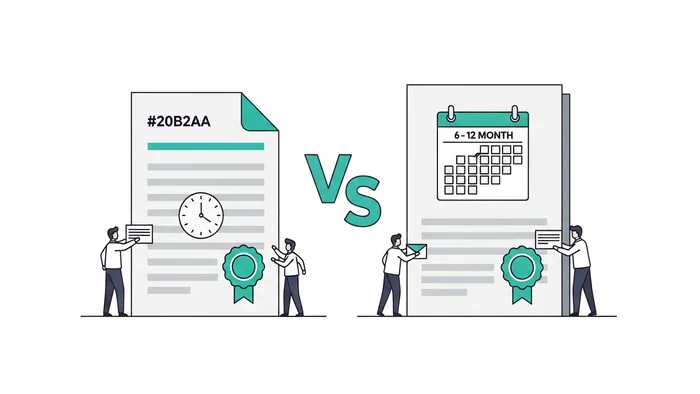
Before anything else, you need to decide between a Type I and Type II report. This is the single largest factor in how long the process takes.
Both report types are governed by the AICPA's System and Organization Controls framework, conducted under AT-C sections 105 and 205 (both part of SSAE 18 as amended; SSAE 21 superseded and renamed AT-C 205, the examination-engagement section SOC 2 reports are issued under, for reports dated on or after June 15, 2022), and issued by a licensed CPA firm. Neither produces a "certificate", the output is an auditor's opinion.
Type I evaluates whether controls are appropriately designed as of a specific date. There is no observation window. The auditor reviews your policies, configurations, and system description to confirm controls are present and designed correctly. Fieldwork runs 2 to 6 weeks, and most companies with partial security controls reach a signed Type I in 2 to 4 months from readiness kickoff.
Type II evaluates both control design and operating effectiveness over a defined period. The AICPA framework does not set a specific review period; in practice, the window typically runs from 3 to 12 months. Schellman, a large AICPA-registered CPA firm specializing in SOC examinations, describes six months as the typical minimum for a first Type 2 engagement. Including preparation and the observation window, a first Type II audit takes 9 to 14 months from readiness kickoff to signed report.
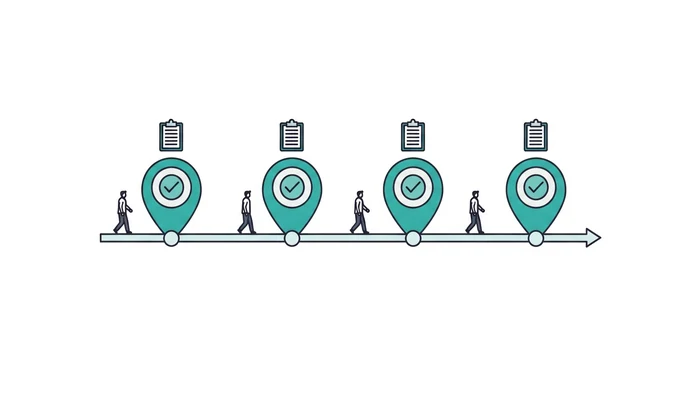
Phase 1: Scoping and readiness assessment
Typical duration: 3 to 6 weeks
This phase answers two questions: what is in scope, and what gaps exist between your current controls and AICPA Trust Services Criteria (TSC)?
The five TSC categories are: Security, Availability, Processing Integrity, Confidentiality, and Privacy. Security is the only mandatory category. Adding any of the other four increases the number of controls you need to implement and the amount of evidence required, a meaningful timeline consideration for a first audit.
Scoping decisions during this phase:
- Which systems store, process, or transmit customer data (these are in scope)
- Which cloud providers, SaaS tools, and databases touch in-scope data
- Which teams and roles interact with in-scope systems
- Which Trust Services Criteria to include based on your customer commitments
A formal readiness assessment closes this phase. It maps your current controls against all applicable TSC criteria and produces a gap list that feeds directly into Phase 2. Companies that skip the readiness assessment and go directly to an auditor tend to discover critical gaps during fieldwork, adding weeks to the timeline and sometimes requiring a restart of the observation window for Type II.
Phase 2: Gap remediation
Typical duration: 4 to 16 weeks, depending on starting maturity
Gap remediation accounts for more timeline variance than any other phase. A company with a working RBAC system, an incident response plan, and annual security training may need four to six weeks to fill remaining gaps (editorial estimate). A company starting with no documented controls may need four months or more (editorial estimate).
In practice, the teams that compress Phase 2 most reliably are the ones that assign a single owner with cross-functional authority before the kickoff call, not midway through remediation. When vendor management, HR policy changes, and access control updates each have a different functional lead with no shared deadline, the interdepartmental handoffs become the timeline bottleneck rather than the work itself.
The gaps that take longest to close are not always the most technically complex:
Vendor management is consistently slow. Collecting SOC 2 reports or completed security questionnaires from each critical sub-processor requires sending requests, waiting, following up, and chasing down legal and security teams at third parties. This process rarely takes less than four to six weeks when more than a handful of vendors are involved (editorial estimate; actual time depends on vendor responsiveness).
HR process changes are slow for a different reason: they touch people and legal. Implementing background checks for existing employees, rolling out formal security awareness training with documented completions, and writing onboarding/offboarding procedures with HR sign-off all require coordination with teams that have other priorities.
Access management, role-based access control, quarterly access reviews, multi-factor authentication across all in-scope systems, is technically straightforward but requires configuration changes across potentially many systems and usually involves some engineering time.
Other common gap areas: change management procedures, incident response plan documentation and tabletop testing, encryption verification across all in-scope data stores, and a documented risk assessment.
Phase 3: Evidence collection and control documentation

Typical duration: 3 to 6 weeks for initial setup; ongoing through the Type II observation period
Once gaps are remediated, you document how each control works and configure the systems that will collect evidence automatically throughout the observation window.
Key work items:
- Finalize written policies: information security policy, acceptable use, data classification, incident response, business continuity, vendor management
- Configure automated evidence collection, cloud provider logs, access review exports, vulnerability scan results, through your GRC platform or shared evidence folder
- Write control descriptions mapped to the applicable TSC criteria, matching the language your auditor will use during fieldwork
- Establish recurring compliance tasks: quarterly access reviews, monthly vulnerability scans, annual risk assessments, annual training completions
For Type II, this phase coincides with the start of the observation window. Evidence must be collected continuously for the full window duration, not gathered in bulk at the end. Missing evidence from the early months of the window is a common audit finding.
Phase 4: Auditor selection and engagement
Typical duration: 2 to 4 weeks for selection; 4 to 8 weeks lead time for popular firms
SOC 2 auditors must be licensed CPA firms. The AICPA governs the standards; it does not certify individual auditors, but it maintains a SOC service organization resource page that can help you verify a firm's standing.
Auditor selection considerations:
- Start conversations during Phase 2, not after remediation is complete. Popular firms in Q4 and Q1 often have 6 to 8 week backlogs (editorial estimate based on scheduling patterns at firms such as Schellman and A-LIGN).
- Request proposals from at least three firms. Pricing, timeline estimates, and audit methodology differ meaningfully across firms.
- Confirm the auditor's technical familiarity with your stack (cloud-native SaaS, healthcare data, infrastructure-as-code, etc.).
- Ask whether the firm offers a pre-audit readiness review, some firms offer this as a paid add-on that reduces the risk of findings during fieldwork.
Some firms, including Schellman, offer tiered SOC 2 programs for early-stage companies with scoped control environments, which can reduce both cost and timeline for first audits.
Phase 5: The audit itself
Type I: 4 to 8 weeks total for fieldwork and report
Type II: 4 to 8 weeks for fieldwork after the observation window closes, plus the window itself
Type I audit
The auditor reviews documentation, configuration evidence, and policy documents as of the report date. Typical sequence:
- Kickoff call and evidence request list: 1 to 2 weeks
- Fieldwork and testing of control design: 2 to 4 weeks
- Report drafting, management review, and response: 2 to 4 weeks
The most common delays: slow responses to evidence requests, personnel unavailable for interviews, and missing documentation discovered during fieldwork that requires remediation before the opinion can be issued.
Type II audit
The observation window must run for the full defined period before fieldwork begins. The auditor then:
- Requests samples from across the entire window (not just the end of the period)
- Tests both control design and operating effectiveness
- Documents exceptions, controls that did not operate as described for any sample period
- Drafts the report with a management response section for any exceptions
For first-time Type II audits, Schellman's published guidance describes six months as typical for the observation window. A-LIGN, another large AICPA-registered CPA firm, confirms that Type II observation periods "typically" run a 3 to 12 month period. The 12-month window is standard for annual renewals and is what most enterprise procurement teams treat as the minimum for mature vendors.
| Audit phase | Type I | Type II |
|---|---|---|
| Observation window | None | 3 to 12 months |
| Fieldwork duration | 2 to 4 weeks | 4 to 8 weeks |
| Report drafting and review | 2 to 4 weeks | 2 to 4 weeks |
| Total (fieldwork + report) | 4 to 8 weeks | 6 to 12 weeks after window closes |
Realistic total timelines by company profile

The ranges below reflect total time from readiness kickoff to signed report. They assume the Security criterion only. Adding Availability, Confidentiality, or Processing Integrity adds 4 to 8 weeks across phases (editorial estimate; actual impact depends on your existing control coverage for the additional criteria).
Early-stage startup (minimal existing security controls)
Type I: 4 to 6 months Type II: 10 to 14 months
The bottleneck is always Phase 2: building a security program from scratch takes time. Vendor management and HR policy changes are usually the longest individual items.
Growth-stage company (some engineering-driven security controls, partial documentation)
Type I: 2 to 4 months Type II: 8 to 12 months
Controls typically exist but are not documented in a form auditors can test. Phase 2 is lighter; Phase 3 (writing control descriptions and collecting initial evidence) takes longer relative to Phase 2.
Mature organization (established security program, prior compliance work)
Type I: 6 to 10 weeks Type II: 6 to 9 months
Gap remediation is minimal. The bottleneck shifts to auditor scheduling and the minimum observation window duration. A mature team using automation for evidence collection can compress the Type II window to 6 months and close the total cycle in under a year.
How to shorten your timeline
Engage an auditor during Phase 2. Starting auditor conversations while gap remediation is still underway eliminates the scheduling gap that adds 4 to 8 weeks for teams that wait until remediation is done.
Start with Security only. Adding Availability, Confidentiality, Processing Integrity, or Privacy to your first audit materially increases the control count and evidence burden. Most enterprise buyers accept a Security-only Type II. Add criteria in renewal years.
Start with Type I if you have near-term deals. A Type I can close in 2 to 4 months. Starting the Type II observation window on the same day the Type I fieldwork begins means the observation period runs concurrently with your Type I, you do not have to wait for the Type I to close to get the Type II clock started.
Use a GRC platform for evidence collection. Platforms that integrate directly with your cloud infrastructure (AWS CloudTrail, GitHub, Okta, etc.) automate the collection of a large portion of common evidence types, reducing the manual overhead in Phase 3 and during the observation window. This matters most for Type II, where you need evidence that spans months rather than a single point in time.
Assign a dedicated compliance owner. SOC 2 spans engineering, HR, legal, and operations. Projects without a named owner who has cross-functional authority tend to stall at interdepartmental hand-offs.
After your first report: the renewal cycle
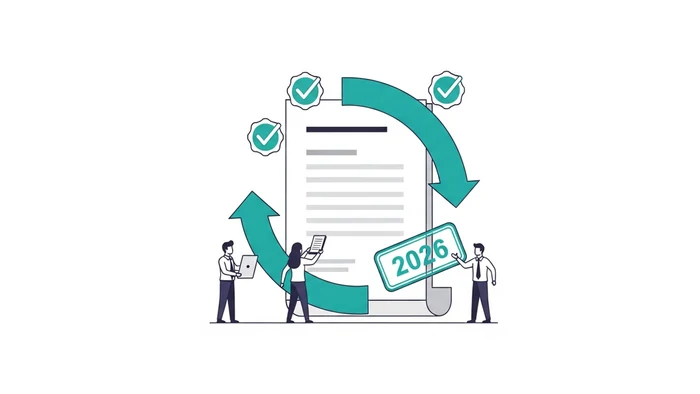
SOC 2 reports are not permanent. A Type II report covers a defined period, usually 12 months, and customers will ask for an updated report once the covered period is older than 12 to 18 months.
Planning for renewal:
- Begin your next Type II observation window before the current one closes, so there is no coverage gap.
- Start the renewal audit engagement 2 to 3 months before your current report period ends.
- Renewal fieldwork is generally shorter than the initial audit because controls are already documented and the auditor is familiar with your environment.
The cost of renewal audits is typically lower than the first-year cost, primarily because tool setup and gap remediation are one-time expenses.
Common mistakes that add months to the timeline
Starting without a readiness assessment. Discovering that your quarterly access reviews have never actually happened, or that a vendor does not have a SOC 2 report, during fieldwork is the most reliable way to add months to a Type II timeline. The readiness gap list is the foundation of Phase 2 planning.
Treating vendor management as a checkbox. Collecting security documentation from third-party processors is slow regardless of how organized you are. Budget 4 to 8 weeks for this task if you have more than a handful of in-scope vendors. Start during Phase 2, not Phase 3.
Waiting to hire an auditor. Firms with the deepest experience in your sector (cloud-native SaaS, healthcare, fintech) are frequently booked out 6 to 8 weeks in Q4 and Q1 (editorial estimate based on scheduling patterns reported by Schellman and A-LIGN). Missing a scheduling window can push your report date by an entire quarter.
Scoping in all five Trust Services Criteria for a first audit. Including all five categories roughly doubles the number of controls in scope. For most first audits, Security alone is sufficient. Expand scope in subsequent cycles once the program is stable.
Collecting evidence in bulk at the end of the observation window. For Type II, evidence must span the entire window. Auditors sample from the beginning, middle, and end of the period. Collecting evidence monthly throughout the window, not in a scramble in the last two weeks, is the difference between clean fieldwork and a finding.
Frequently Asked Questions
How long does a first SOC 2 Type I audit take?
For a company with partial security controls already in place, 2 to 4 months from readiness kickoff to signed report is a realistic target. Companies starting from near-zero security documentation may need 4 to 6 months. The main variables are how long gap remediation takes and how quickly your auditor can schedule fieldwork.
What is the minimum observation period for SOC 2 Type II?
The AICPA framework does not prescribe an absolute minimum, but the range cited in practice is 3 to 12 months. Most auditors and buyers treat 6 months as the practical floor for a first Type II engagement. Enterprise procurement teams typically require 12 months for annual renewals.
Can you get a SOC 2 report in 30 days?
No. Even for the most mature organizations using automated evidence collection, the audit fieldwork and report drafting alone take 4 to 8 weeks minimum. Vendor claims of "audit-ready in 30 days" typically mean your evidence collection is configured and policies are drafted, not that a signed report has been issued.
How often does a SOC 2 report need to be renewed?
Reports cover a defined period and become stale. Most customers will ask for an updated report once the covered period is 12 to 18 months old. The standard renewal cycle is annual, start the next observation window before the current report period ends to maintain continuous coverage.
Do you need a separate auditor for Type I and Type II?
No. The same firm issues both. Most companies use the same auditor for the Type I engagement and the subsequent Type II, since auditor familiarity with your environment reduces fieldwork time and increases the quality of the opinion. Switching auditors between Type I and Type II is not prohibited, but it is uncommon because of the learning curve cost.
What is the difference between SOC 2 and ISO 27001 in terms of timeline?
Both cover information security controls, but they differ in fundamental structure. SOC 2 is an auditor attestation, a CPA firm issues an opinion, governed by AICPA standards. ISO 27001 is a certification, an accredited certification body audits your information security management system against ISO/IEC 27001:2022 requirements and issues a certificate valid for three years with annual surveillance audits. ISO 27001 initial certification typically takes 8 to 16 months for a company building an ISMS from scratch (editorial estimate; individual timelines vary by organization size and existing ISMS maturity; see our ISO 27001 certification guide for the full path). SOC 2 Type II first audit timelines are similar. The two are not interchangeable in buyer requirements; see our SOC 2 vs ISO 27001 comparison for detail.
Sources used
- AICPA & CIMA. "System and Organization Controls (SOC) Suite of Services." Accessed 2026-05-12.
- AICPA Assurance Services Executive Committee. "2017 Trust Services Criteria (With Revised Points of Focus, 2022)," the criteria examined during the fieldwork phases described in this timeline. Accessed 2026-09-17.
- Schellman. "SOC 2 Examination." Accessed 2026-05-12. https://www.schellman.com/services/soc-compliance-and-attestations/soc-2
- A-LIGN. "SOC 2 Audit." Accessed 2026-05-12. https://www.a-lign.com/soc-2-audit
- ISO/IEC. "ISO/IEC 27001:2022, Information security, cybersecurity and privacy protection." Accessed 2026-05-12.
Last reviewed: 2026-10-02. This article was prepared by the Security Compliance Guide Editorial Team. We use AI to draft initial summaries of publicly available cybersecurity compliance documentation, then verify every claim against primary sources before publication. We are not licensed auditors, attorneys, or compliance consultants. For binding decisions, consult a qualified professional. See our editorial standards for full sourcing rules.