NIST 800-53 Controls: The 20 Families Explained
NIST 800-53 is the most comprehensive catalog of security and privacy controls published by the U.S. federal government. Originally developed for federal information systems, it has become the go-to reference for any organization that needs a structured, defensible approach to cybersecurity risk management.
Whether you are pursuing FedRAMP authorization, building a compliance program from scratch, or strengthening your existing security posture, understanding NIST 800-53 controls is essential. This guide breaks down the control families, explains how they work in practice, and shows you how to implement them without drowning in bureaucracy.
What Is NIST 800-53?
NIST Special Publication 800-53 is a catalog of security and privacy controls maintained by the National Institute of Standards and Technology. The current version, Revision 5, was released in September 2020 and updated in December 2020. It contains over 1,000 individual controls organized into 20 control families.
Unlike frameworks that tell you what to achieve (like the NIST Cybersecurity Framework), NIST 800-53 tells you how to achieve it. It provides specific, actionable controls that organizations can select and tailor based on their risk profile.
Who Needs NIST 800-53?
Federal agencies are required to implement NIST 800-53 controls under FISMA (Federal Information Security Modernization Act). But the standard's influence extends far beyond government:
- Federal contractors and subcontractors handling Controlled Unclassified Information (CUI)
- Cloud service providers seeking FedRAMP authorization (FedRAMP baselines map directly to 800-53 controls)
- Healthcare organizations looking to strengthen HIPAA compliance with more specific technical controls
- Financial institutions that want a structured supplement to PCI DSS or SOX requirements
- Defense contractors subject to CMMC (which draws heavily from NIST 800-171, itself derived from 800-53)
- Any organization that wants a proven, government-backed control catalog
According to NIST, over 50,000 organizations worldwide reference SP 800-53 in their security programs.
The 20 Control Families Explained

NIST 800-53 Rev 5 organizes controls into 20 families. Each family addresses a specific domain of security or privacy. Here is what each one covers and why it matters.
Access Control (AC)
The AC family contains 25 base controls covering user access management, account types, access enforcement, separation of duties, least privilege, and remote access. This is typically the largest implementation effort for most organizations.
Key controls: AC-2 (Account Management), AC-3 (Access Enforcement), AC-6 (Least Privilege), AC-17 (Remote Access).
Awareness and Training (AT)
Four base controls requiring security awareness training, role-based training for privileged users, and training records. Often underestimated, but consistently cited in breach post-mortems as a root cause gap.
Audit and Accountability (AU)
16 base controls for event logging, audit record content, audit storage, and audit review. Without proper audit trails, incident response becomes guesswork.
Key controls: AU-2 (Event Logging), AU-3 (Content of Audit Records), AU-6 (Audit Record Review), AU-12 (Audit Record Generation).
Assessment, Authorization, and Monitoring (CA)
Nine base controls covering security assessments, system authorization (formerly "certification and accreditation"), continuous monitoring, and penetration testing.
Configuration Management (CM)
14 base controls for baseline configurations, change control, least functionality, and software restrictions. Poor configuration management is behind a significant percentage of breaches.
Key controls: CM-2 (Baseline Configuration), CM-6 (Configuration Settings), CM-7 (Least Functionality), CM-8 (System Component Inventory).
Contingency Planning (CP)
13 base controls for backup, recovery, and continuity of operations. Covers everything from data backup strategies to alternate processing sites.
Identification and Authentication (IA)
12 base controls for user identification, authenticator management, and multi-factor authentication. With credential-based attacks accounting for over 40% of breaches (per Verizon's 2025 DBIR), this family deserves close attention.
Incident Response (IR)
Ten base controls covering incident handling, monitoring, reporting, and response planning. Organizations with a tested incident response plan save an average of $2.66 million per breach compared to those without one, according to IBM's Cost of a Data Breach Report 2025.
Maintenance (MA)
Six base controls for system maintenance, maintenance tools, and remote maintenance oversight.
Media Protection (MP)
Eight base controls for media access, marking, storage, transport, and sanitization. Critical for organizations handling classified or sensitive data on physical media.
Physical and Environmental Protection (PE)
23 base controls covering physical access, monitoring, visitor control, emergency procedures, and environmental safeguards like fire suppression and temperature controls.
Planning (PL)
11 base controls for security planning, rules of behavior, and system security plan development.
Program Management (PM)
32 base controls (the largest family) covering organization-wide security program management, risk management strategy, and enterprise architecture. These controls operate at the organizational level rather than the system level.
Personnel Security (PS)
Nine base controls for personnel screening, termination, transfer, and access agreements. The human element remains one of the weakest links in security.
Personally Identifiable Information Processing and Transparency (PT)
Eight base controls added in Rev 5, covering consent, privacy notices, data minimization, and individual rights. This family bridges the gap between security controls and privacy regulations like GDPR and CCPA.
Risk Assessment (RA)
Ten base controls for risk assessments, vulnerability scanning, and risk response. This family drives the entire control selection process: you cannot choose appropriate controls without understanding your risks first.
Key controls: RA-3 (Risk Assessment), RA-5 (Vulnerability Monitoring and Scanning), RA-7 (Risk Response).
System and Services Acquisition (SA)
23 base controls covering security in the system development lifecycle, supply chain risk management, and developer security testing.
System and Communications Protection (SC)
51 base controls (the most technical family) covering boundary protection, cryptographic protections, network segmentation, and secure communication protocols.
Key controls: SC-7 (Boundary Protection), SC-8 (Transmission Confidentiality and Integrity), SC-13 (Cryptographic Protection), SC-28 (Protection of Information at Rest).
System and Information Integrity (SI)
23 base controls for flaw remediation, malicious code protection, security alerts, and system monitoring.
Key controls: SI-2 (Flaw Remediation), SI-3 (Malicious Code Protection), SI-4 (System Monitoring), SI-7 (Software, Firmware, and Information Integrity).
Supply Chain Risk Management (SR)
12 base controls added in Rev 5, covering supply chain risk assessment, acquisition strategies, and component authenticity. Supply chain attacks rose 742% between 2019 and 2024, making this family increasingly critical.
NIST 800-53 Control Baselines
Not every organization needs to implement all 1,000+ controls. NIST provides three control baselines that map controls to impact levels:
| Baseline | Impact Level | Approximate Controls | Typical Use Case | |----------|-------------|---------------------|-----------------| | Low | Low impact systems | ~130 controls | Public-facing websites, non-sensitive data | | Moderate | Moderate impact systems | ~325 controls | Most business systems, CUI handling | | High | High impact systems | ~425 controls | National security, critical infrastructure, classified systems |
The baseline selection process works like this:
- Categorize your information system using FIPS 199 (confidentiality, integrity, availability impact levels)
- Select the corresponding baseline from NIST 800-53B
- Tailor the baseline by adding or removing controls based on your specific risk assessment
- Document your rationale for any deviations
How NIST 800-53 Relates to Other Frameworks
NIST 800-53 does not exist in isolation. It maps to and supports multiple other compliance frameworks:
| Framework | Relationship to 800-53 | |-----------|----------------------| | NIST CSF | CSF provides the "what"; 800-53 provides the "how". CSF categories map to 800-53 control families | | FedRAMP | FedRAMP baselines are direct subsets of 800-53 controls with additional requirements | | NIST 800-171 | 800-171 is a derived subset of 800-53 controls specifically for protecting CUI in non-federal systems | | CMMC | CMMC practices trace back to 800-171 controls, which trace back to 800-53 | | SOC 2 | SOC 2 Trust Service Criteria can be mapped to 800-53 controls for implementation guidance | | HIPAA | HIPAA Security Rule requirements map to specific 800-53 control families | | ISO 27001 | ISO 27001 Annex A controls have significant overlap with 800-53 families | | PCI DSS | PCI DSS requirements can be addressed using corresponding 800-53 controls |
Implementation: A Practical 5-Step Approach

Step 1: Scope and Categorize
Define the boundaries of your information system and categorize it using FIPS 199. Be specific about what data the system processes, stores, and transmits.
Step 2: Select Your Baseline and Tailor
Choose Low, Moderate, or High baseline. Then tailor it:
- Remove controls that are not applicable (document why)
- Add controls from higher baselines for specific risks
- Apply overlays for special environments (cloud, classified, privacy)
Step 3: Implement Controls
Work through controls family by family. For each control:
- Define the implementation (policy, procedure, technical mechanism, or combination)
- Assign responsibility to a specific role
- Set implementation timelines
- Document compensating controls where full implementation is not feasible
Step 4: Assess
Conduct a formal security assessment (per CA-2) to verify controls are implemented correctly and operating as intended. Use NIST SP 800-53A as the assessment guide.
Step 5: Authorize and Monitor
Obtain formal authorization to operate (per CA-6). Then establish continuous monitoring (per CA-7) to track control effectiveness over time. This is not a "set and forget" process.
Common Implementation Mistakes
Treating it as a checkbox exercise. NIST 800-53 controls are meant to reduce risk, not generate paperwork. If your control documentation says "implemented" but nobody can explain how, you have a problem.
Ignoring control enhancements. Base controls have enhancements that add specificity. For Moderate and High baselines, many enhancements are required, not optional. Review the baseline carefully.
Skipping the tailoring step. Applying a baseline without tailoring means you are either implementing unnecessary controls (wasting resources) or missing controls your specific environment requires.
Not mapping to existing controls. If you already have SOC 2 compliance or ISO 27001 certification, many 800-53 controls are already satisfied. Map existing controls before assuming you need to build from scratch.
Underestimating PM family controls. Program Management controls apply at the organizational level. Skipping them means your system-level controls lack the governance structure to sustain them.
Frequently Asked Questions
What is the difference between NIST 800-53 and NIST CSF?
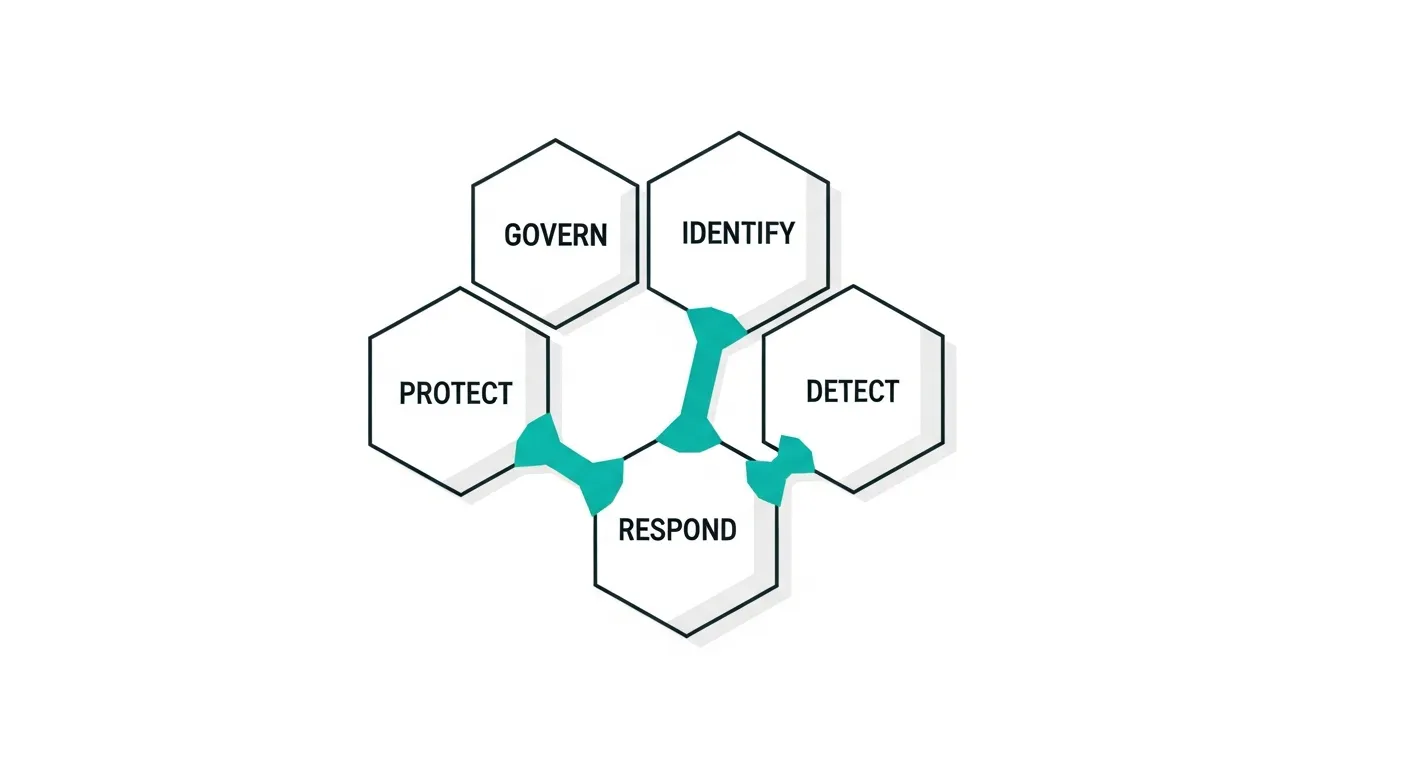
NIST CSF (Cybersecurity Framework) is a high-level risk management framework organized into six functions: Govern, Identify, Protect, Detect, Respond, and Recover. NIST 800-53 is a detailed catalog of over 1,000 specific security controls. CSF tells you what outcomes to achieve; 800-53 provides the specific controls to achieve them. Most organizations use CSF for strategy and 800-53 for implementation.
Is NIST 800-53 mandatory?
NIST 800-53 is mandatory for U.S. federal agencies and their contractors under FISMA. For private sector organizations, it is voluntary but widely adopted as a best practice. If you handle government data, pursue FedRAMP, or contract with federal agencies, compliance is effectively required.
How long does NIST 800-53 implementation take?
For a Moderate baseline implementation from scratch, expect 12 to 18 months for a mid-size organization. Organizations with existing compliance programs (SOC 2, ISO 27001) can often achieve it in 6 to 9 months by mapping existing controls. The timeline depends heavily on organizational size, system complexity, and available resources.
How often should NIST 800-53 controls be assessed?
NIST recommends continuous monitoring, but practical assessment cycles vary. Most organizations conduct a full assessment annually, with ongoing monitoring of high-priority controls. FedRAMP requires annual full assessments plus monthly vulnerability scanning and continuous monitoring.
What is the cost of NIST 800-53 compliance?
Costs vary dramatically based on scope. For a Moderate baseline implementation, expect $50,000 to $500,000 for initial implementation (internal staff time, tools, consulting) and $30,000 to $150,000 annually for ongoing assessment and monitoring. GRC platforms can reduce ongoing costs by automating evidence collection and control monitoring.