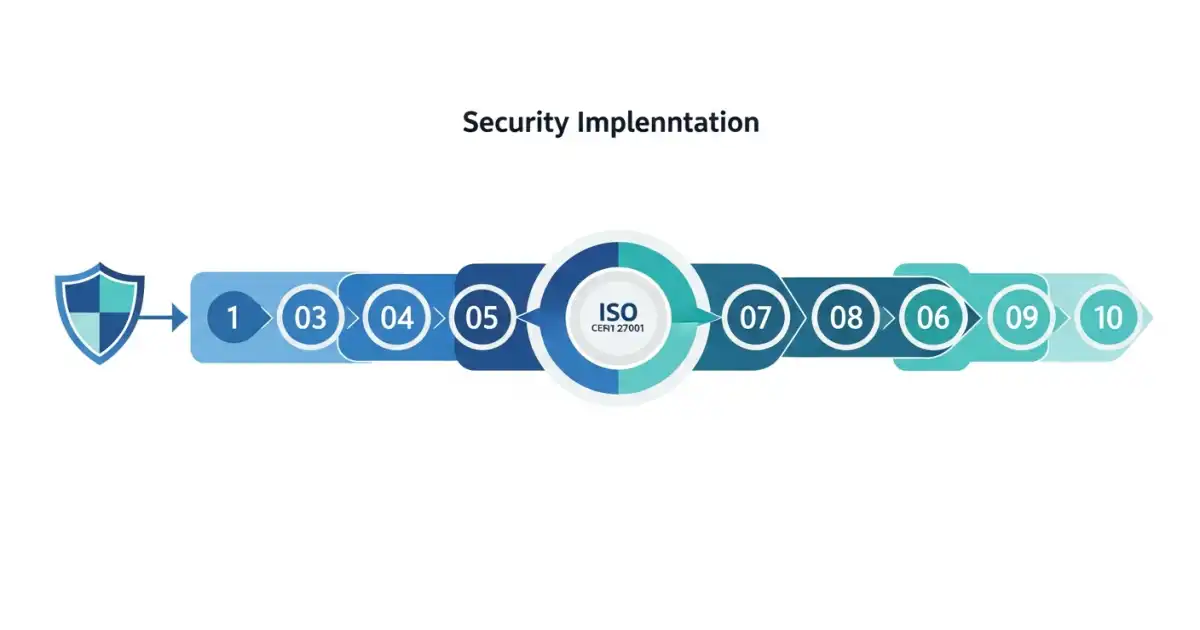
ISO 27001 Implementation Guide: 10 Steps to Certification
This ISO 27001 implementation guide walks you through every phase of getting certified. With 93 controls across 4 categories, most organizations spend 9 to 18 months completing their ISO 27001 implementation. This guide breaks down the entire process into clear, actionable steps so your team knows exactly what to do, when to do it, and how much it will cost.
Whether you are a SaaS startup preparing for enterprise sales or a mid-market company responding to customer security questionnaires, ISO 27001 certification signals that your information security management system (ISMS) meets the gold standard recognized by the International Organization for Standardization.
What Is ISO 27001 and Why Does It Matter?
ISO 27001 is the international standard for information security management systems. Published by the International Organization for Standardization (ISO) and the International Electrotechnical Commission (IEC), it provides a systematic approach to managing sensitive company and customer information.
The standard matters for three practical reasons:
- Customer trust. Enterprise buyers increasingly require ISO 27001 certification before signing contracts. It is one of the most commonly requested vendor security credentials in enterprise procurement questionnaires and RFPs.
- Regulatory alignment. ISO 27001 maps directly to GDPR, HIPAA, SOC 2, and the NIST Cybersecurity Framework. Controls you implement to satisfy one framework frequently carry over to the others, which reduces the incremental work of pursuing multiple certifications.
- Risk reduction. A certified ISMS forces continuous risk identification, treatment, and review. That discipline is the point of the standard: organizations catch and close gaps that go unnoticed without a formal management system.
ISO 27001 Implementation: The 10-Step Process

Step 1: Define the Scope of Your ISMS
Before writing a single policy, you need to define what your ISMS covers. This means identifying:
- Which business units, departments, or products are included
- Which locations (offices, data centers, remote workers) fall within scope
- Which information assets need protection
- Which third-party relationships are relevant
Step 2: Conduct a Gap Analysis
Compare your current security posture against ISO 27001 requirements. A gap analysis reveals:
- Controls you already have in place (you will likely have more than you think)
- Controls that need improvement
- Controls that are completely missing
- Documentation gaps
Most organizations find they already satisfy a meaningful share of ISO 27001 requirements through existing security practices they never formally mapped to the standard. The gap analysis tells you exactly where to focus your effort.
Step 3: Build Your Risk Assessment Framework
ISO 27001 is fundamentally risk-based. You need a formal methodology for:
- Identifying risks to your information assets
- Analyzing risks by likelihood and impact
- Evaluating risks against your risk acceptance criteria
- Treating risks through controls, transfer, avoidance, or acceptance
The risk assessment feeds directly into your Statement of Applicability (SoA), which documents which of the 93 Annex A controls you will implement and why.
Step 4: Write Your Information Security Policies
ISO 27001 requires documented policies covering:
- Information security policy (top-level, signed by management)
- Access control policy
- Asset management policy
- Cryptography policy
- Physical security policy
- Operations security policy
- Communications security policy
- Supplier relationships policy
- Incident management policy
- Business continuity policy
Step 5: Implement Technical and Organizational Controls
Based on your risk assessment and SoA, implement the controls from Annex A. The 2022 revision of ISO/IEC 27002, which Annex A of ISO 27001 mirrors, organizes controls into four categories:
| Category | Controls | Examples |
|---|---|---|
| Organizational | 37 controls | Information security roles, threat intelligence, asset management |
| People | 8 controls | Screening, awareness training, disciplinary process |
| Physical | 14 controls | Physical entry controls, equipment security, clear desk policy |
| Technological | 34 controls | Access rights, malware protection, encryption, logging |
You do not need to implement all 93 controls. Your SoA documents exactly which ones apply, and the number varies by organization since it depends entirely on your own risk assessment and scope.
Step 6: Train Your Team
Every employee who handles information within the ISMS scope needs security awareness training. ISO 27001 requires:
- Initial training for all personnel
- Role-specific training for IT, development, and security teams
- Regular refresher training (annually at minimum)
- Records of all training activities
Step 7: Operate the ISMS
Run your ISMS for at least 3 months before your certification audit. During this period:
- Follow the policies and procedures you documented
- Collect evidence of control effectiveness
- Log security incidents and responses
- Monitor access controls and system logs
- Conduct internal reviews of ISMS performance
This operational period generates the evidence your auditor will review.
Step 8: Conduct an Internal Audit
Before your certification audit, conduct a thorough internal audit. This should:
- Cover all clauses of ISO 27001 and all applicable Annex A controls
- Be performed by someone independent of the ISMS implementation (this can be an internal team member who was not involved, or an external consultant)
- Document findings as conformities, minor nonconformities, or major nonconformities
- Result in corrective actions for any nonconformities
Step 9: Management Review
Top management must formally review the ISMS before the certification audit. The management review covers:
- Results of the internal audit
- Status of corrective actions
- Changes in external and internal context
- Risk assessment results
- Opportunities for improvement
- Resource adequacy
Document the management review meeting minutes, decisions made, and action items assigned.
Step 10: Certification Audit (Stage 1 and Stage 2)
The certification audit happens in two stages:
Stage 1 (Documentation Review): The auditor reviews your ISMS documentation, policies, SoA, and risk assessment. This typically takes 1 to 2 days and can be done remotely. The auditor identifies any documentation gaps that must be resolved before Stage 2.
Stage 2 (Implementation Audit): The auditor visits your organization (or conducts a remote audit) to verify that your ISMS operates as documented. They interview staff, review evidence, and test controls. This takes 3 to 10 days depending on scope.
If no major nonconformities are found, you receive your ISO 27001 certificate.
ISO 27001 Implementation Timeline
| Phase | Duration | Activities |
|---|---|---|
| Planning | 1-2 months | Scope definition, gap analysis, project plan |
| Risk Assessment | 1-2 months | Asset inventory, risk identification, SoA |
| Policy Development | 1-3 months | Writing policies, procedures, work instructions |
| Implementation | 2-4 months | Deploying controls, training, system changes |
| Operation | 3+ months | Running the ISMS, collecting evidence |
| Internal Audit | 2-4 weeks | Comprehensive audit and corrective actions |
| Certification Audit | 1-2 months | Stage 1 and Stage 2 audits |
| Total | 9-18 months | Depends on scope and existing maturity |
Smaller organizations with existing security programs can compress this toward the low end, around 9 months. Larger enterprises or those starting from scratch should plan for 12 to 18 months.
What an ISO 27001 Quote Actually Prices
ISO does not publish a price list, and neither do the accredited certification bodies that issue the certificate (BSI, DNV, SGS, and others each quote independently). Your total spend is a function of four variables, not a fixed fee:
- Organization size. Certification bodies calculate audit duration, and therefore audit fees, largely from the headcount and number of sites inside your ISMS scope. More people and locations in scope means more audit days.
- Consultant vs. in-house. Hiring a consultant for gap analysis, policy writing, and internal audit adds a services fee on top of the certification body's audit fee. Doing the work in-house trades that fee for internal staff time.
- GRC platform. Tools like Vanta, Drata, and Secureframe carry a subscription fee but cut the hours spent on manual evidence collection and control monitoring, which is usually the largest driver of consultant billable time. For a detailed comparison, see our guide to GRC software platforms.
- Scope. A single product line in scope costs less than a full-organization certification, both in audit days and in internal remediation work.
Because pricing is quote-based and varies by certification body and consultant, request quotes against your actual headcount, site count, and scope rather than budgeting from a generic figure.
Common ISO 27001 Implementation Mistakes

These mistakes come up repeatedly across ISO 27001 implementations:
- Treating it as an IT project. ISO 27001 is a management system standard. It requires involvement from HR, legal, operations, and executive leadership, not just the security team.
- Over-scoping. Including everything in your first certification attempt leads to delays, higher costs, and audit fatigue. Start with your core business and expand.
- Copy-pasting policies. Auditors recognize generic templates immediately. Policies must reflect your actual operations, risks, and organizational context.
- Ignoring the risk assessment. Some organizations treat the risk assessment as a checkbox exercise. It is the foundation of your entire ISMS. A weak risk assessment leads to irrelevant controls and audit findings.
- Waiting too long for the operational period. You need at least 3 months of ISMS operation before the Stage 2 audit. Starting the operational period too late pushes your entire timeline.
Maintaining Your ISO 27001 Certification
Certification is not a one-time event. To maintain your certificate:
- Surveillance audits occur annually (years 1 and 2 after certification)
- Recertification audit happens every 3 years
- Continuous monitoring of controls and ISMS performance is required
- Management reviews must continue at least annually
- Internal audits must be conducted at least annually
- Annual surveillance audits are shorter and less expensive than the initial certification audit, since the certification body is confirming your ISMS still operates as certified rather than assessing it from scratch; get the exact fee from your certification body
ISO 27001 Implementation for Startups and SMBs
Many founders and SMB owners assume ISO 27001 implementation is only for large enterprises. That is not the case. The standard scales to any organization size, and a small, tightly scoped startup is often the fastest profile to certify, landing toward the low end of the 9 to 18 month range covered above.
For startups and small businesses, focus on these shortcuts:
- Use a GRC platform from day one. Manual spreadsheet tracking adds months to the ISO 27001 implementation timeline.
- Hire a consultant for the gap analysis and internal audit only. Handle policy writing and control implementation in-house.
- Scope tightly. Cover only your production environment and customer data, not every department.
- Combine your ISO 27001 implementation with SOC 2 preparation. The two frameworks overlap heavily on access control, change management, and risk assessment, so pursuing them together avoids re-doing the same evidence collection twice.
For a broader look at how ISO 27001 compares with other options, see our compliance framework comparison.
Frequently Asked Questions

How long does ISO 27001 implementation take?
Most organizations complete ISO 27001 implementation in 9 to 18 months. Smaller companies with existing security programs can finish closer to the 9-month floor. The timeline depends on scope, existing maturity, and available resources.
Can a small startup get ISO 27001 certified?
Yes. ISO 27001 is scalable by design. A 10-person startup can get certified with a focused scope. The key is matching your ISMS complexity to your actual risk profile, not over-engineering it.
Do I need a consultant for ISO 27001 implementation?
Not technically required, but strongly recommended for first-time implementations. A consultant who has taken organizations through certification before helps you avoid the scoping and documentation mistakes that cause major nonconformities, and speeds up the phases where teams typically get stuck: writing policies that reflect real operations and building a defensible risk assessment.
What is the difference between ISO 27001 and SOC 2?
ISO 27001 is an international certification standard focused on building a complete ISMS. SOC 2 is a North American attestation focused on trust service criteria. Many organizations pursue both. For a detailed comparison, see our ISO 27001 vs SOC 2 guide.
How much does ISO 27001 certification cost?
There is no published price list. Total cost is quote-based and scales with your headcount, number of sites, scope, and whether you hire a consultant or use a GRC platform. See what an ISO 27001 quote actually prices above, and get quotes from certification bodies against your actual scope.
What happens if you fail the certification audit?
You receive nonconformity reports. Minor nonconformities can be corrected within a set timeframe (usually 90 days) without a full re-audit. Major nonconformities require corrective action and a follow-up audit of the affected areas. You are not "blacklisted" from future attempts.
Primary Sources
This article references the following authoritative sources:
- ISO/IEC 27002, ISO/IEC 27002:2022 information security controls
- ISO management system standards, ISO management system standards overview
- NIST Cybersecurity Framework, NIST Cybersecurity Framework 2.0
Last reviewed: 2026-09-15. This article was prepared by the Security Compliance Guide Editorial Team. We use AI to draft initial summaries of publicly available cybersecurity compliance documentation, then verify every claim against primary sources before publication. We are not licensed auditors, attorneys, or compliance consultants. For binding decisions, consult a qualified professional. See our editorial standards for full sourcing rules.