SOC 2 vs ISO 27001: Which Do You Need First?
The short answer: if your customers are primarily US-based B2B enterprises, pursue SOC 2 first. If you are selling into European markets or to enterprises with international procurement teams, ISO 27001 often clears vendor questionnaire gates faster. Many companies eventually need both, but the sequencing decision comes down to which one your buyers are actually asking for right now.
Both frameworks address information security management. They share significant conceptual overlap. But they differ structurally in ways that affect cost, timeline, and the ongoing maintenance burden after you achieve the initial milestone.
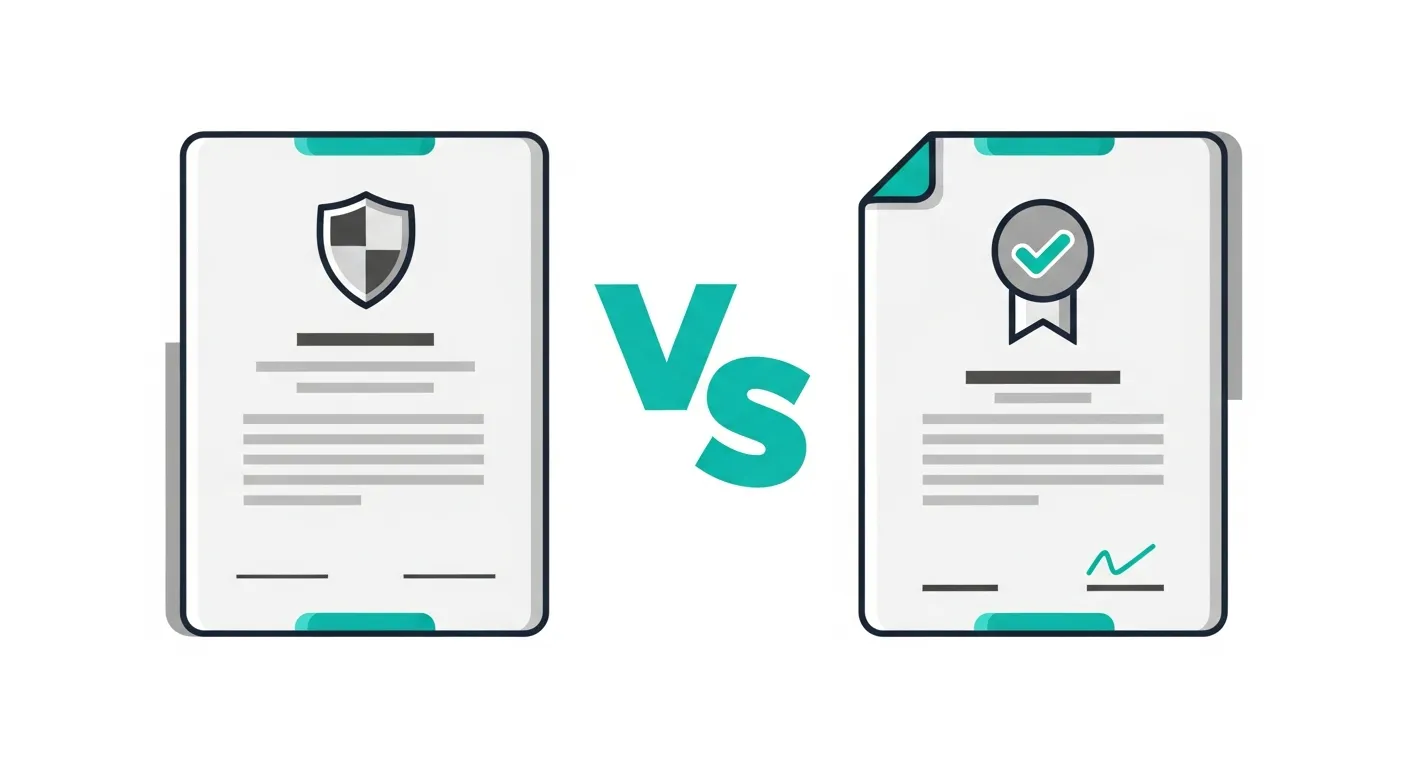
The Fundamental Difference: Report vs Certification
This distinction matters more than it first appears.
SOC 2 produces an audit report, not a certification. A SOC 2 Type II report is a formal attestation by an independent CPA firm that your controls operated effectively over a defined period (typically 12 months). The report is a document you share with customers under NDA. There is no central registry of SOC 2-compliant companies. Your report expires when a new audit period begins.
ISO 27001 produces a certification issued by an accredited certification body. Your company name appears on a publicly searchable registry. The certification has a three-year validity period with annual surveillance audits and a full recertification audit in year three. This public, verifiable nature is one of ISO 27001's core advantages in international procurement.
For many enterprise procurement teams, a current ISO 27001 certificate reduces or eliminates the need to complete lengthy vendor security questionnaires. SOC 2 reports accomplish similar things in the US market but carry less weight in European and Asian enterprise sales contexts.
Framework Structure: Trust Criteria vs Controls
SOC 2 is organized around five Trust Services Criteria, defined by the AICPA: Security (CC), Availability (A), Confidentiality (C), Processing Integrity (PI), and Privacy (P). Security is mandatory. The others are optional and included based on what is relevant to your service. Most SaaS companies audit against Security only, or Security plus Availability and Confidentiality.
ISO 27001 is organized around 93 controls in Annex A (updated from 114 in the 2013 version to 93 in the 2022 revision) grouped into four themes: Organizational Controls, People Controls, Physical Controls, and Technological Controls. The framework requires companies to define an Information Security Management System (ISMS) and demonstrate that the ISMS is operating and improving. The PDCA (Plan-Do-Check-Act) cycle is central to ISO's philosophy.
In practical terms, SOC 2 is more prescriptive about the evidence format while ISO 27001 gives more flexibility in control implementation. This means ISO 27001 is often better suited to companies with complex or unusual technical environments, while SOC 2's defined criteria make it easier to scope correctly for the first time.
One structural note: SOC 2 reports have a defined scope boundary. You choose which systems and services are "in scope," and the audit covers only those. ISO 27001 scopes the entire organization's ISMS, though you can define boundaries around specific business units or services. This scoping flexibility is why ISO 27001 works well for large enterprises with diverse product lines, while SOC 2 is easier to scope tightly for a single SaaS product.
Cost Comparison
Neither framework is cheap. The costs below reflect typical ranges for companies with 20-200 employees in cloud-native environments.
SOC 2 Type II typical costs:
- Audit firm fees: $15,000-$35,000 for a single-criteria audit (Security only)
- Multi-criteria audits (Security + Availability + Confidentiality): $25,000-$50,000
- Compliance automation platform (secureframe/">drata-vs-secureframe/">Vanta, Drata, Secureframe): $10,000-$25,000 per year
- Internal labor for gap remediation and control implementation: 200-400 hours, varies by team
- Legal review (policy templates, NDA for report distribution): $2,000-$8,000
SOC 2 Type I (point-in-time snapshot, no observation period) costs 30-50% less and can be achieved faster. It is increasingly less accepted by enterprise buyers, who prefer Type II. Some companies use Type I as a bridge while completing the Type II observation period.
ISO 27001 typical costs:
- Certification body fees: $10,000-$30,000 for initial certification audit
- Annual surveillance audit: $5,000-$15,000 per year
- External consultant or ISMS implementation support: $15,000-$50,000 (common for first-time implementations)
- Compliance automation with ISO 27001 support: overlaps with SOC 2 cost if using same platform
- Internal labor: typically higher than SOC 2 due to ISMS documentation requirements, 400-800 hours is common
The three-year certification cost model of ISO 27001 means that the first year is the most expensive. SOC 2 requires an annual audit every year, which creates a more predictable but ongoing cost structure.
If budget is genuinely constrained, SOC 2 Type II tends to be the lower-cost path for year one, particularly if you use a compliance automation platform with a pre-built SOC 2 program. ISO 27001's documentation depth makes it harder to DIY without consultant support on the first attempt.
One cost that is often underestimated in both frameworks: ongoing compliance maintenance. After the initial certification or report, you are committing to a continuous program: quarterly access reviews, annual policy reviews, evidence collection throughout the year, and the annual audit itself. Budget for recurring operational costs, not just the first-year achievement cost.
Timeline Comparison
SOC 2 Type II timeline:
- Gap assessment and control implementation: 8-16 weeks
- Observation period (controls must operate for minimum 6 months for Type II): 6-12 months
- Audit fieldwork and report issuance: 6-10 weeks
Total time from starting to holding a Type II report: 9-14 months is realistic for a first-time program. Companies that start with Type I can cut this to 4-6 months for the initial report, then enter the Type II observation period.
ISO 27001 timeline:
- ISMS design and documentation: 12-20 weeks
- Control implementation and internal audit: 8-12 weeks
- Stage 1 audit (documentation review): 2-4 weeks
- Remediation gap: 2-6 weeks
- Stage 2 audit (implementation verification): 2-4 weeks
- Certificate issuance: 2-4 weeks after Stage 2
Total time from starting to holding a certificate: 9-15 months is realistic. Unlike SOC 2, there is no mandatory observation period. A company can theoretically move faster if the ISMS is well-implemented and the certification body's schedule permits.
In practice, both frameworks take roughly the same amount of time for a motivated, adequately resourced team. ISO 27001 tends to feel slower because the documentation workload is front-loaded. SOC 2 Type II feels slower because of the mandatory observation period.
Geographic and Market Relevance
This is the clearest decision criteria for most companies.
SOC 2 is a US-origin standard with dominant market share in North American enterprise software procurement. If your ICP (ideal customer profile) is US-based companies with 1,000+ employees, SOC 2 is what their security teams know and request. It is also deeply embedded in US SaaS procurement workflows: tools like OneTrust, Whistic, and SecurityScorecard all treat SOC 2 reports as a primary evidence type.
ISO 27001 carries more weight in Europe, the Middle East, Asia-Pacific, and Latin America. UK GDPR alignment, DORA (Digital Operational Resilience Act) compliance in EU financial services, and NIS2 Directive requirements all treat ISO 27001 certification as a meaningful trust signal. European enterprise procurement teams often require it or strongly prefer it over SOC 2.
If your sales pipeline is split geographically, both frameworks eventually become necessary. The sequencing question then becomes: which market are you trying to close deals in right now?
When You Need Both
Most SaaS companies that scale internationally end up needing both. The good news is that the control overlap is substantial: ISO 27001's Annex A controls and SOC 2's Common Criteria share roughly 70-75% of their substance. A company with a mature SOC 2 program can typically layer on ISO 27001 certification in 4-6 months rather than 9-15. The reverse is also true.
The most efficient sequencing for an internationally-minded company: achieve SOC 2 Type II first (it has higher urgency for most US-headquartered SaaS companies), then use the existing control framework as the foundation for ISO 27001 certification in year two or three. Most compliance automation platforms support both frameworks simultaneously, so the marginal cost of adding the second framework is primarily audit fees and consultant time, not a full rebuild.
A Decision Framework
Work through these questions in order:
- Which framework are your current enterprise prospects actually requesting? If 80% of your deals involve US buyers asking for SOC 2, that is your answer.
- Are you trying to enter regulated industries (healthcare, financial services, government)? HIPAA, FedRAMP, and PCI DSS have their own requirements that may override this choice.
- Do you have a hard deadline? A prospect demanding SOC 2 by a contract signing date in six months constrains your options in ways that a general "we should get certified eventually" goal does not.
- What is your internal security maturity? ISO 27001 has a higher documentation burden. If your team lacks a dedicated security function, SOC 2 with a compliance automation platform may be the more realistic path.
- What does your long-term geographic expansion plan look like? If Europe is a priority within 18 months, consider pursuing both frameworks concurrently rather than sequentially.
FAQ
Q: Does ISO 27001 certification satisfy SOC 2 requirements?
No. ISO 27001 and SOC 2 are separate frameworks with separate audit processes and separate output documents. Achieving one does not satisfy or replace the other. Some auditors offer combined assessments that produce both outputs from a single engagement, which reduces overall cost and time. Ask your audit firm if they offer a combined SOC 2 + ISO 27001 engagement.
Q: Is SOC 2 accepted in Europe?
SOC 2 reports are recognized in Europe, particularly among software-forward procurement teams familiar with US security practices. However, ISO 27001 certification is more commonly required or preferred by European enterprise buyers. A SOC 2 Type II report will satisfy some European prospects but will not satisfy all of them. If your European pipeline is significant, ISO 27001 certification is the more reliable door-opener.
Q: What is the difference between SOC 2 Type I and Type II?
SOC 2 Type I is a point-in-time assessment confirming that your controls are suitably designed. SOC 2 Type II assesses whether those controls operated effectively over a defined period (typically 6-12 months). Enterprise buyers overwhelmingly prefer Type II because it provides evidence of sustained control operation, not just a design snapshot. Type I is useful as an interim milestone while completing the observation period for Type II.
Q: Can a startup pursue ISO 27001 before SOC 2?
Yes, and some do. ISO 27001 is particularly valuable for European-founded companies or startups selling primarily into European enterprise markets. The documentation burden is real, but it is manageable with external consultant support or a compliance automation platform that includes ISO 27001. The certification's three-year validity and public registry listing also provide marketing value that a SOC 2 report (which is shared under NDA) does not.