PCI DSS vs SOC 2: Do You Need Both?
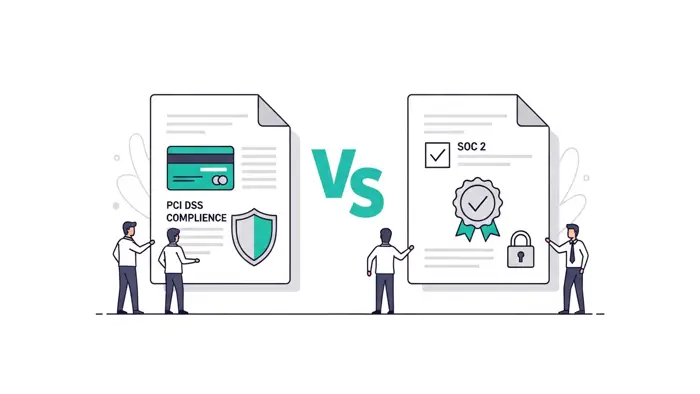
PCI DSS and SOC 2 are both critical security frameworks that startups encounter early. PCI DSS protects payment card data through prescriptive rules. SOC 2 provides flexible assurance about your security practices. According to a 2025 Coalfire survey, 68% of SaaS companies with over 50 employees maintain both. This guide helps you decide which you need.
PCI DSS: Payment Card Data Protection
The Payment Card Industry Data Security Standard applies to any organization that stores, processes, or transmits cardholder data. It is mandatory, not voluntary. The PCI Security Standards Council (founded by Visa, Mastercard, AmEx, Discover, JCB) enforces it regardless of company size or transaction volume.
PCI DSS applies to merchants accepting card payments, payment processors, e-commerce platforms, and SaaS companies handling payment data. Even startups using Stripe or Square retain some PCI DSS obligations. Outsourcing payment processing reduces scope but does not eliminate compliance requirements.
PCI DSS 4.0 (mandatory since March 31, 2025) has 12 core requirements organized into 6 control objectives: install network security controls, apply secure configurations, protect stored account data, encrypt cardholder data in transit, protect against malware, develop secure software, restrict access by need to know, authenticate users, restrict physical access, log all access, test security regularly, and maintain security policies.
Non-compliance carries financial penalties from $5,000 to $100,000 per month, plus potential loss of the ability to process card payments, which can shut down a business.
SOC 2: Trust-Based Security Assurance

SOC 2 is a voluntary audit framework developed by the AICPA. It evaluates controls across five Trust Service Criteria: Security (always required), Availability, Processing Integrity, Confidentiality, and Privacy. Organizations select which criteria to include based on their services.
SOC 2 is typically needed by SaaS companies, managed service providers, data hosting firms, HR and payroll processors, and B2B service organizations. While not legally mandated, most enterprise buyers require a SOC 2 Type 2 report before signing contracts, making it a de facto business requirement for B2B startups.
Most SaaS companies include Security, Availability, and Confidentiality in their SOC 2 scope. A SOC 2 audit typically costs $20,000 to $100,000 depending on scope and complexity. The observation period for Type 2 reports runs 3 to 12 months.
Head-to-Head Comparison
| Factor | PCI DSS | SOC 2 |
|---|---|---|
| Governing body | PCI Security Standards Council | AICPA |
| Mandatory? | Yes (card data handlers) | No (contractually required) |
| Scope | Cardholder data environment only | Entire service or defined system |
| Approach | Prescriptive (specific technical rules) | Flexible (principles-based criteria) |
| Audit type | QSA assessment or SAQ self-assessment | CPA firm audit |
| Cost | $15,000 to $150,000+ | $20,000 to $100,000+ |
| Timeline | 3 to 12 months initial compliance | 3 to 9 months audit readiness |
| Penalties | $5,000 to $100,000/month fines | Lost customers and contracts |
Where They Overlap
These frameworks share significant common ground. Organizations pursuing both can reduce total compliance costs by 30 to 40 percent by mapping shared controls, according to compliance platforms like Drata and Vanta.
Shared control areas include:
- Access controls: Both require role-based access, unique user IDs, MFA for privileged accounts, and regular access reviews
- Encryption: Both require data protection (PCI DSS specifies AES-128/256 and TLS 1.2+; SOC 2 is flexible on algorithms)
- Logging and monitoring: Both require audit trails and log review. PCI DSS specifies 12 months retention with 3 months immediately available
- Vulnerability management: Both require regular scanning and remediation. PCI DSS mandates quarterly internal and external scans
- Incident response: Both require documented plans, regular testing, and defined escalation procedures
- Change management: Both require formal processes for system modifications
- Vendor management: Both require assessment of third-party providers with access to sensitive data
A practical control mapping shows that PCI DSS Requirements 1, 3, 4, 6, 7, 8, 10, 11, and 12 have direct parallels in SOC 2 Common Criteria CC6.1 through CC8.1. Building controls once and mapping them to both frameworks is more efficient than maintaining separate programs.
Do You Need Both? Decision Framework

PCI DSS only: You process card payments but do not serve enterprise B2B clients. You are a small merchant or retailer with limited B2B relationships. Your customers do not request SOC 2 reports.
SOC 2 only: You provide B2B services but fully outsource payment processing to a PCI-compliant provider like Stripe or Square. Your startup needs SOC 2 to unlock enterprise sales pipelines.
Both: You are a SaaS company processing payments AND serving enterprise clients. You are a fintech company or payment processor. Your enterprise clients require SOC 2 AND you handle cardholder data directly. This is the most common scenario for growing startups, especially in fintech, healthtech, and e-commerce infrastructure.
Implementation Strategy for Startups
For SMBs and startups with limited budgets, start with whichever framework has more immediate revenue impact:
Start with SOC 2 if enterprise sales pipeline is stalled without it and you can outsource payment processing through Stripe or a similar provider. Most B2B SaaS startups choose this path because enterprise deals often stall at the security review stage.
Start with PCI DSS if non-compliance penalties are imminent, payment processing is core to your product, or you handle cardholder data directly rather than through a tokenization provider.
For parallel implementation (recommended when both apply), plan 6 to 9 months:
- Months 1-2: Joint gap assessment against both frameworks
- Months 2-4: Implement shared controls (access, encryption, logging, policies)
- Months 4-6: Address framework-specific requirements (PCI segmentation, ASV scanning; SOC 2 availability monitoring)
- Months 6-9: Engage auditors for both assessments
Cost optimization strategies: use a compliance automation platform that supports both (Vanta, Drata, Secureframe, Sprinto), choose a CPA firm that handles both audits at reduced rates, consolidate policy documentation with mapped sections, and minimize PCI scope through tokenization.
Common Mistakes to Avoid
Treating them as interchangeable. Customers requesting one framework will not accept the other. A SOC 2 report cannot satisfy PCI DSS requirements, and a PCI DSS ROC does not replace SOC 2.
Running separate compliance programs. Independent programs create redundant documentation, duplicate evidence collection, and significantly higher costs. Build a unified program with mapped controls from day one.
Ignoring scope differences. PCI DSS scope covers only the cardholder data environment. SOC 2 scope covers the entire service described in the audit. Defining scope incorrectly leads to gaps in one framework or wasted effort in the other.
Underestimating ongoing maintenance. Both frameworks require annual reassessments. PCI DSS also requires quarterly ASV scans. SOC 2 Type 2 covers a continuous observation period. Budget for year-round compliance activities, not just a pre-audit sprint.
Frequently Asked Questions

Q: Does SOC 2 cover PCI DSS requirements? A: No. While they share overlapping controls like access management and encryption, SOC 2 does not address PCI-specific requirements like cardholder data segmentation, ASV scanning, or payment application security. You cannot use a SOC 2 report to demonstrate PCI DSS compliance.
Q: Can I do PCI DSS and SOC 2 audits at the same time? A: Yes, and many organizations do. Running parallel assessments with the same audit firm reduces scheduling burden and allows you to present shared evidence once. Some firms offer combined engagement pricing at a 15 to 25 percent discount.
Q: Which certification should a startup get first? A: Most B2B SaaS startups begin with SOC 2 because enterprise sales pipelines stall without it. If your startup handles payment data directly (not through Stripe or similar), PCI DSS compliance is legally required and should come first.
Q: How much does maintaining both certifications cost annually? A: Annual maintenance typically ranges from $50,000 to $200,000 for mid-sized companies. This includes audit fees ($25,000 to $80,000 combined), platform subscriptions ($10,000 to $50,000), quarterly ASV scans ($1,000 to $5,000), and ongoing remediation. Automation platforms reduce total cost by 30 to 50 percent.
Q: What compliance automation tools support both PCI DSS and SOC 2? A: Vanta, Drata, Secureframe, Sprinto, and Tugboat Logic all support both frameworks. They automate evidence collection, policy management, and continuous monitoring with pre-built control mappings that reduce duplicate effort significantly.